

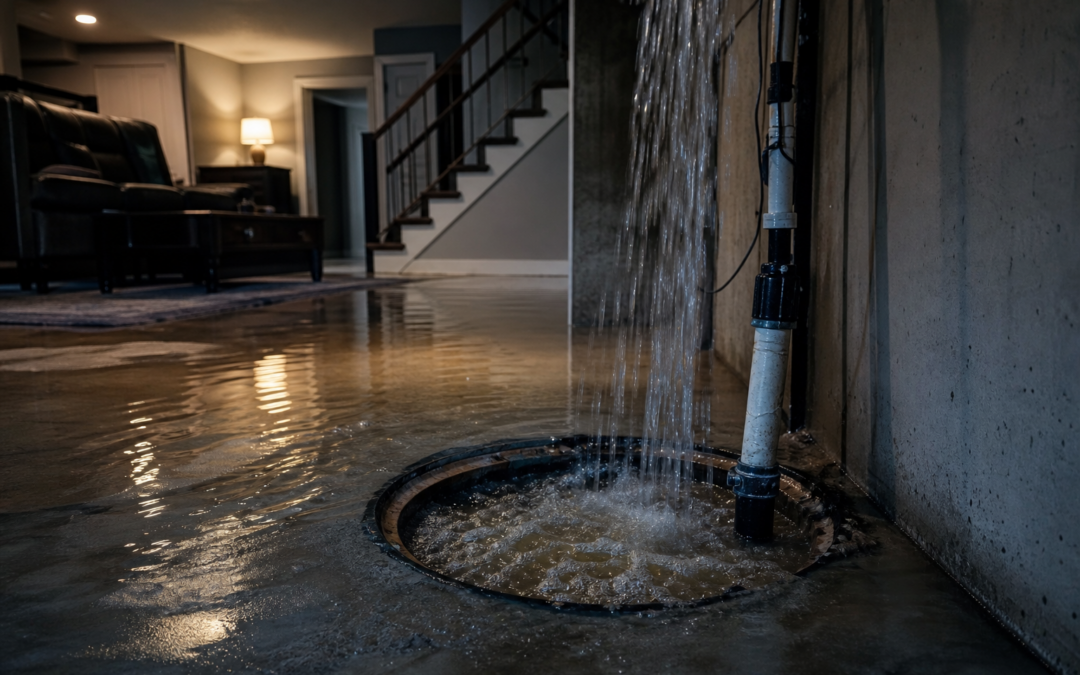
Your sump pump is the last line of defense between a dry basement and a disaster. Most of the time, it runs quietly in the background and you barely think about it. But when a heavy storm rolls through Northern Colorado and your sump pump fails — you’ll know within minutes.
July and August are peak monsoon months along the Front Range. Afternoon thunderstorms drop heavy rain on already-saturated soil, and sump pumps that handled everything fine all year suddenly can’t keep up. When they fail, water rises fast — and the damage starts immediately.
If your sump pump just failed and your basement is taking on water, here’s what you need to know.
Why Sump Pumps Fail During Heavy Rain
Sump pump failures rarely come out of nowhere. They’re almost always caused by one of these factors — usually during the worst possible moment:
- Power outage. Summer storms knock out power across Northern Colorado regularly. When the power goes, your sump pump goes with it — right when you need it most. Unless you have a battery backup, your basement is unprotected the moment the lights flicker.
- Float switch stuck or jammed. The float switch tells the pump when to turn on. Over time, it can get caught on the side of the sump pit, tangled in wiring, or stuck in the “off” position. The water rises, but the pump never kicks on.
- Overwhelmed capacity. Most residential sump pumps move 1,500 to 3,000 gallons per hour. During a major storm with sustained heavy rain, water can flow into the pit faster than the pump can push it out. The pump runs nonstop — and eventually overheats or can’t keep up.
- Clogged discharge line. The pipe that carries water away from your house can get blocked by debris, ice (in winter), or even dirt that washed into the line. When the discharge line is blocked, the pump runs but the water has nowhere to go.
- Old or worn-out pump. Sump pumps have a typical lifespan of 7 to 10 years. If yours is older than that, the motor, impeller, and seals are all degrading — and the pump may work fine during light rain but fail under heavy demand.
What Happens to Your Basement in the First Hours
Once a sump pump fails, the timeline accelerates quickly:
- Within minutes: Water starts rising in the sump pit and overflowing onto the basement floor. If you have a finished basement, water immediately starts wicking into carpet, pad, drywall, and baseboards.
- Within 1-2 hours: Several inches of standing water can accumulate depending on the water table and storm intensity. Furniture legs, stored boxes, and anything on the floor are soaking.
- Within 6-12 hours: Water has penetrated under flooring, behind walls, and into structural materials. The moisture level in drywall and framing is rising fast — creating the conditions mold needs to start growing.
- Within 24-48 hours: Mold spores can begin colonizing in warm, damp environments. In July in Northern Colorado, your basement is exactly that environment.
The bottom line: speed matters. Every hour water sits in your basement, the scope of damage — and the cost to fix it — increases.
What to Do Immediately
If your sump pump has failed and water is entering your basement:
1. Stay safe. Do not wade into standing water if there’s any chance it’s in contact with electrical outlets, appliances, or your breaker panel. If water is near anything electrical, do not enter the area. If you can safely reach the breaker box from dry ground, turn off power to the basement.
2. Call Revive Restoration — before you call insurance.
Your restoration company should be the first call. We know exactly what documentation your insurance adjuster needs, and we begin emergency mitigation immediately — which your policy requires. When your adjuster arrives, the work is already underway, fully documented, and your claim goes smoother.
Call us at (720) 340-3499 — we respond in 60 minutes, 24/7, even during active storms.
3. Move what you can — safely. If you can access the basement without wading through deep water or going near electrical hazards, move valuables, documents, and electronics to higher ground. Don’t risk your safety for replaceable items.
4. Document everything. Use your phone to photograph and video every affected area before any cleanup starts. Wide shots, close-ups, the sump pit, the water level. Your insurance company needs to see the full picture.
5. Don’t try to pump it yourself with a shop vac. A wet-dry vacuum can move a few gallons at a time. Our commercial extraction equipment removes thousands. And if the water has any contamination from a backed-up drain or outside sources, it needs professional handling.
Does Insurance Cover Sump Pump Failure?
This is one of the most common questions we hear — and the answer catches a lot of homeowners off guard.
Standard homeowner’s insurance typically does not cover sump pump failure or water backup by default. Many policies exclude it entirely. Some offer an optional “water backup” or “sump pump overflow” endorsement — but you have to add it to your policy before the damage happens.
Here’s what that means in practice:
- If you have the water backup endorsement, your policy may cover the damage — but often with a separate, lower limit (commonly $5,000 to $25,000).
- If you don’t have the endorsement, you may be paying for the entire restoration out of pocket.
- If the flooding was caused by an outside source (rising groundwater, storm runoff entering the home), standard policies almost never cover it. That requires separate flood insurance.
This is exactly why calling Revive first matters. We’ll assess the situation, document the source and scope of damage, and help you understand what your policy is likely to cover — before you file a claim.
How Revive Handles Sump Pump Basement Flooding
When we arrive at a sump pump failure, here’s what happens:
1. Emergency water extraction. We deploy commercial pumps and truck-mounted extraction equipment to remove standing water as fast as possible. Speed is everything — every hour counts.
2. Moisture mapping. We use moisture meters and thermal imaging to find water in places you can’t see — behind walls, under flooring, in ceiling cavities of the floor below. Water from sump failures spreads far beyond the visible flood line.
3. Structural drying. Industrial air movers and dehumidifiers go in immediately. We monitor moisture levels daily until readings confirm everything is fully dry. In a typical sump pump flood, drying takes 3 to 5 days.
4. Cleaning and antimicrobial treatment. If the water that entered your basement came through a floor drain, carried soil or sediment, or has any contamination, we clean and treat every affected surface to prevent mold and eliminate health risks.
5. Restoration and repair. Once everything is dry and clean, we rebuild what was damaged — drywall, baseboards, flooring, paint. One team handles the whole job.
Protect Yourself Before the Next Storm
If your sump pump saved you this time — or if you’re reading this before a failure happens — here’s how to reduce your risk:
- Install a battery backup sump pump. This is the single most effective thing you can do. When power goes out, the backup kicks in automatically.
- Test your sump pump regularly. Pour a bucket of water into the pit every few months. If the pump doesn’t activate, fix it now — not during a storm.
- Replace pumps older than 7-10 years. Even if it seems to be working fine, an aging pump is a gamble during heavy demand.
- Check your discharge line. Make sure it’s clear, properly routed away from your foundation, and not kinked or blocked.
- Add the water backup endorsement to your insurance policy. Call your agent and add it today — it’s typically inexpensive and can save you thousands.
We Respond Fast — Because Basement Flooding Can’t Wait
At Revive Restoration, we’ve helped homeowners across Fort Collins, Loveland, Windsor, Johnstown, and the broader Northern Colorado area recover from sump pump failures and basement flooding. We know how stressful it is — and we know that speed makes the difference between a manageable situation and a major one.
Revive Restoration — (720) 340-3499 — 24/7 Emergency Response Across Northern Colorado