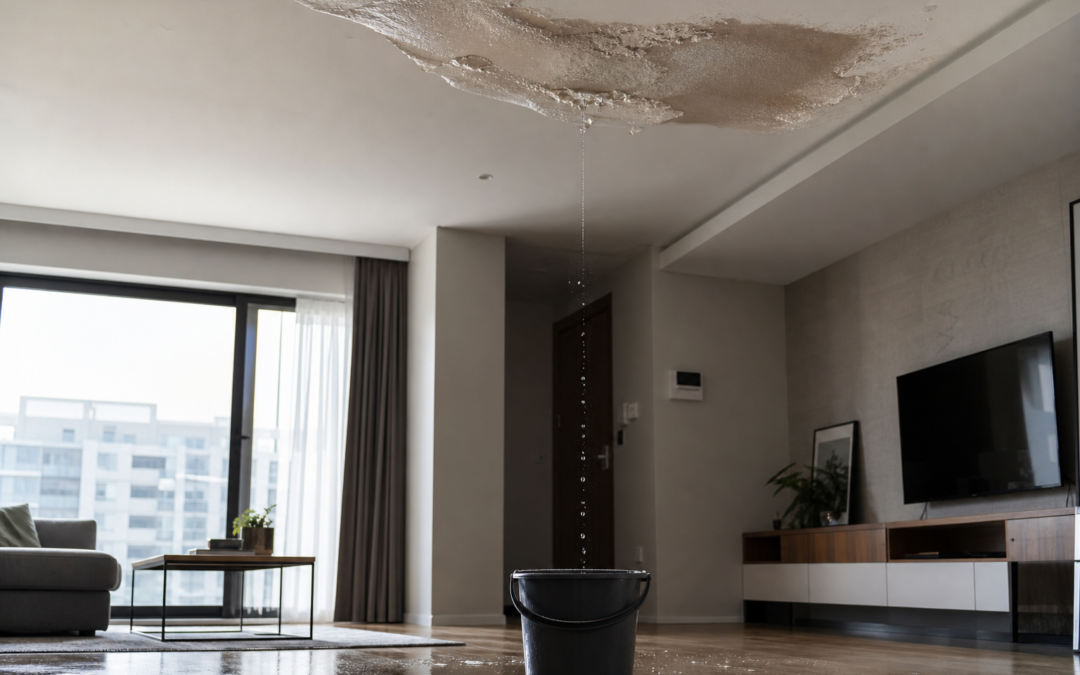
Water damage in a single-family home is stressful. Water damage in an apartment or condo is stressful and confusing, because the first question is not “how do we fix it” — it is “whose problem is this?”
Your upstairs neighbor’s water heater failed and now your ceiling is dripping. Your new apartment has a soft spot in the bathroom floor and a musty closet the previous tenant never mentioned. Your HOA says it is your unit; your insurer says it is the master policy. Meanwhile the water is still there, and mold does not wait for anybody to sort out paperwork.
Call Revive Restoration at (720) 340-3499. We work with tenants, condo owners, property managers, and HOAs across Northern Colorado every week, and we can usually tell you within one visit who needs to be involved.
Renters: who is responsible for what
The general rule in Colorado rentals splits it two ways:
The landlord is typically responsible for the building and its systems — plumbing, roof, structure, HVAC, and the habitability of the unit. If a pipe in the wall fails, a roof leaks, or a shared line backs up, that is the owner’s side of the ledger, and Colorado’s warranty of habitability requires them to address conditions that make a unit unsafe or uninhabitable.
The tenant is typically responsible for their own belongings — furniture, electronics, clothing. Your landlord’s policy does not cover your stuff. That is what renters insurance is for, and it is usually inexpensive. Tenants can also be held responsible for damage caused by their own negligence: an overflowing tub, an unreported leak that ran for weeks, a disconnected washer hose.
What to do as a renter, in order:
- Stop the water if you can safely reach a shutoff
- Photograph and video everything before you move anything, including your damaged belongings
- Notify your landlord or property manager in writing — text or email, so there is a timestamp. Verbal notice is the number one thing that falls apart later
- Move what you can to a dry area and keep receipts for anything you spend
- If the unit is unsafe or uninhabitable, say that explicitly in your written notice
- Call us if nothing is happening. Many landlords are glad to have a restoration company already on site with documentation in hand
Condo owners: master policy vs. your policy
Condos add a layer. Most associations carry a master policy covering the building and common elements, while each owner carries an HO-6 unit policy. Where the line falls depends entirely on your association’s declarations and bylaws — some are “bare walls” (you own everything inside, including drywall and fixtures), some are “all-in” (the master policy covers original fixtures and finishes).
Two things you should do before you ever have a loss: read the water damage and insurance sections of your declarations, and ask your agent whether you carry loss assessment coverage. After a loss, request the declarations and the master policy’s deductible in writing — a high master deductible is often what determines who ends up paying.
When the water comes from your neighbor’s unit
This is the most common multi-unit call we get. A supply line, water heater, toilet, or dishwasher fails upstairs and the damage lands on you.
- Notify the HOA or property management immediately, in writing, and ask them to shut off the affected line
- Document your damage thoroughly — including the ceiling, walls, flooring, and contents
- File on your own policy too, even if you believe the neighbor is at fault. Your insurer can pursue their insurer through subrogation, and that is a much faster path than doing it yourself
- In Colorado, a neighbor is generally liable for damage caused by their negligence, but not automatically for every accidental failure. This is exactly why documentation matters
- Do not wait for the fault question to be resolved before drying the unit. Delay is how a water claim becomes a mold claim
Why moving fast matters more in multi-unit buildings
Water in a shared building travels sideways and down through shared wall cavities, floor assemblies, and chases. A failure in one unit routinely affects three or four. Mold can begin growing within 24 to 48 hours, and once it is in a shared assembly it becomes an association-level problem instead of a unit-level one.
Our guide on how fast mold grows after water damage covers the timeline, and it is short.
How Revive works in apartments and condos
We are used to buildings with more than one decision-maker. We can coordinate access with property management, keep the association informed, work in occupied buildings with containment so neighbors are not disrupted, and produce separate documentation per unit so each carrier gets exactly what it needs. We handle everything from extraction and structural drying to mold remediation and rebuild.
And we will tell you plainly if the damage is not as bad as it looks. The inspection is free.
Call Revive before you call insurance
Whether you are a tenant, a unit owner, or a board member, the sequence that protects you is the same: get it documented properly by a restoration professional first, then file. Moisture maps, photos, and a written scope turn a “he said, she said” claim into a factual one — and in a multi-unit loss there are always multiple parties with an interest in the story.
Water damage in your Northern Colorado apartment or condo? Call Revive Restoration at (720) 340-3499 — 24/7, free inspection, and we will help you figure out who to call and what happens next.