Your water heater works harder in a Northern Colorado winter than at any other time of year. The water coming into your home from the city or your well can be close to freezing in January, so the tank has to heat it further, more often. Add holiday guests and longer, hotter showers, and winter is when a lot of older tanks finally give out.
When a tank fails, it can release its full 40 to 80 gallons, plus whatever keeps flowing from the supply line until someone shuts it off. In a basement or a closet next to finished living space, that’s a lot of water. Here’s how to tell if your water heater is near the end, the simple upkeep that helps it last, and what to do if it fails.
Already dealing with a leak? Skip to our step-by-step guide: Water Heater Leak? What to Do Before It Destroys Your Floor.
Warning Signs Your Water Heater Is Failing
- Age. Most tank water heaters last around 8 to 12 years. The date is usually coded into the serial number on the label. If yours is past 10, start planning for a replacement.
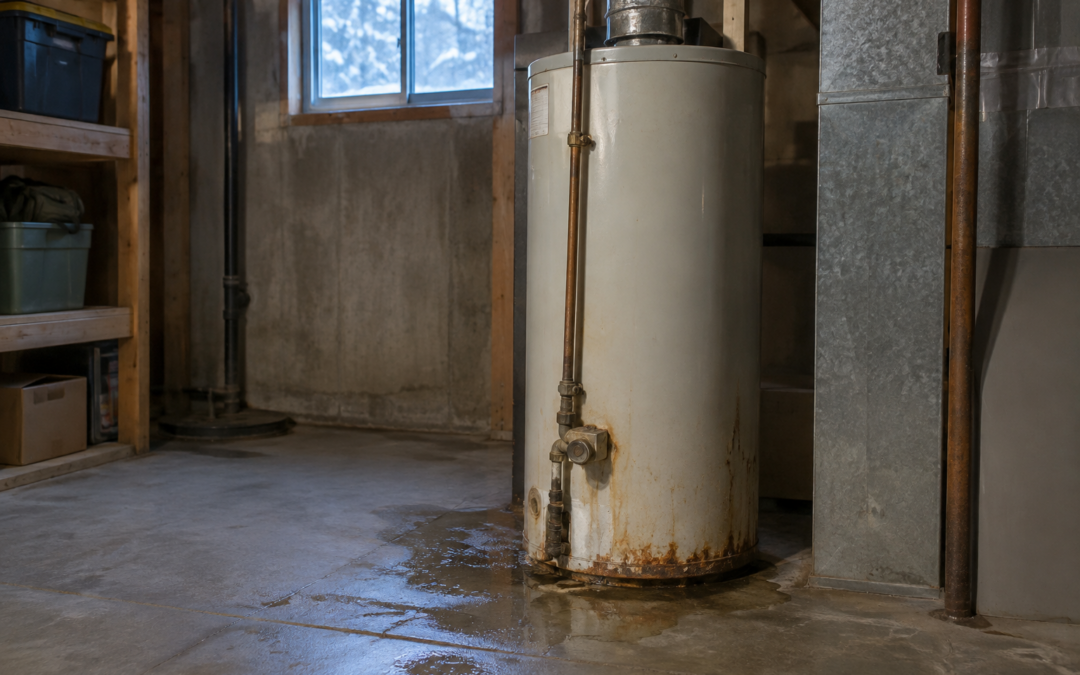
- Rust. Rusty water from the hot tap only, or rust and corrosion around the base, valves or fittings, means the tank lining is breaking down.
- Popping, rumbling or banging. That’s sediment built up on the bottom of the tank. Northern Colorado’s hard water speeds this up, and sediment makes the tank overheat and wear faster.
- Running out of hot water faster than you used to, or water that’s only lukewarm.
- Moisture or a small puddle around the base, or a dripping temperature and pressure (T&P) relief valve.
- Water stains on the floor, nearby drywall, or the ceiling below if the heater is in an upstairs closet. Here’s what a ceiling water stain can tell you.
Simple Upkeep That Helps a Water Heater Last
- Flush the tank once a year. Draining a few gallons from the valve at the bottom clears out sediment. In hard-water areas, it’s one of the best things you can do.
- Test the T&P valve. Lift the lever briefly and let it snap back. It should release a little water and then stop. If it won’t open or keeps dripping, have it replaced.
- Have the anode rod checked every few years. This metal rod corrodes so your tank doesn’t. Once it’s gone, the tank itself starts to rust.
- Put a drain pan underneath with a line to a floor drain, especially if the heater is near carpet, a finished room or an upstairs floor.
- Add a leak sensor or automatic shutoff. A smart leak detector or auto-shutoff valve can warn you, or stop the water, the moment the tank starts leaking.
- Keep the area clear so you can see the base of the tank and get to the shutoff valves fast.
Repair or Replace?
A dripping valve, a bad heating element or a faulty thermostat can usually be repaired by a licensed plumber. But if the tank itself is leaking from the body or the bottom, it can’t be fixed and needs to be replaced. If your heater is over 10 years old and showing more than one warning sign, replacing it on your schedule is almost always less stressful than replacing it after it floods the basement.
If Your Water Heater Floods the Basement
- Shut off the cold water supply at the valve on top of the tank. If you can’t reach it, use the main water shutoff.
- Turn off the energy source. For gas, turn the control knob to “off” or “pilot.” For electric, switch off the breaker. Don’t touch the breaker panel if you’re standing in water.
- Keep people and pets out of the water. Water from a tank can be very hot.
- Take photos of the tank, the label and the water before cleanup.
- Get the water out and the drying started. Finished basements soak up water fast through carpet pad, drywall and framing. See our guide to finished basement water damage and how to deal with a flooded basement.
Our water heater burst restoration service covers extraction, drying and repairs from start to finish.
Who Pays for Water Heater Damage?
Many homeowners policies cover sudden water damage from a tank that bursts, but not the water heater itself, and not damage from a slow leak that went on for weeks. Policies vary, so check yours and ask your agent. Learn more in our post on whether homeowners insurance covers water damage in Colorado. Renters and landlords can find the basics in our renters guide to who pays when a pipe bursts.
Call Revive Before You Call Insurance
If your water heater lets go, call us before you call insurance. We’ll come out for a free inspection, find out how far the water spread with moisture meters, and get the drying started so mold doesn’t get a foothold. Then you’ll know exactly what you’re dealing with before you talk to your adjuster.
Revive Restoration is an IICRC-certified firm serving homeowners across Northern Colorado 24/7. Call (720) 340-3499 or visit our emergency service page. We’ll help you get dry and get back to normal.
Frequently Asked Questions
How long does a water heater last in Colorado?
Most tank water heaters last around 8 to 12 years. Hard water in much of Northern Colorado speeds up sediment buildup, so yearly flushing helps a tank reach the longer end of that range.
Why do water heaters fail more in winter?
Incoming water is much colder in winter, so the heater runs longer and more often to bring it up to temperature. Holiday guests and longer showers add to the load, which pushes aging tanks past their limit.
What are the warning signs a water heater is about to fail?
Watch for a tank older than 10 years, rusty hot water, rust around the base, popping or rumbling sounds, running out of hot water quickly, a dripping relief valve, or moisture around the bottom of the tank.
What should I do first if my water heater is leaking?
Shut off the cold water supply valve on top of the tank, turn off the gas or the breaker, keep people away from hot water, take photos and call Revive Restoration at (720) 340-3499 to extract the water and start drying.
Does homeowners insurance cover a burst water heater?
Many policies cover sudden water damage from a burst tank but not the water heater itself, and not damage from slow, long-term leaks. Policies vary, so check yours. Call Revive before you call insurance for a free inspection.
Serving all of Northern Colorado: Revive Restoration responds across Fort Collins, Loveland, Windsor, Johnstown, Greeley, Longmont, Timnath, Berthoud, Wellington, Severance, Erie, and every community on our service areas map. Learn more about our water damage restoration and mold remediation services, see how our restoration process works, or request a free inspection.