A finished basement is usually the best value in a Northern Colorado house. It’s also, by a wide margin, the most expensive room to dry out.
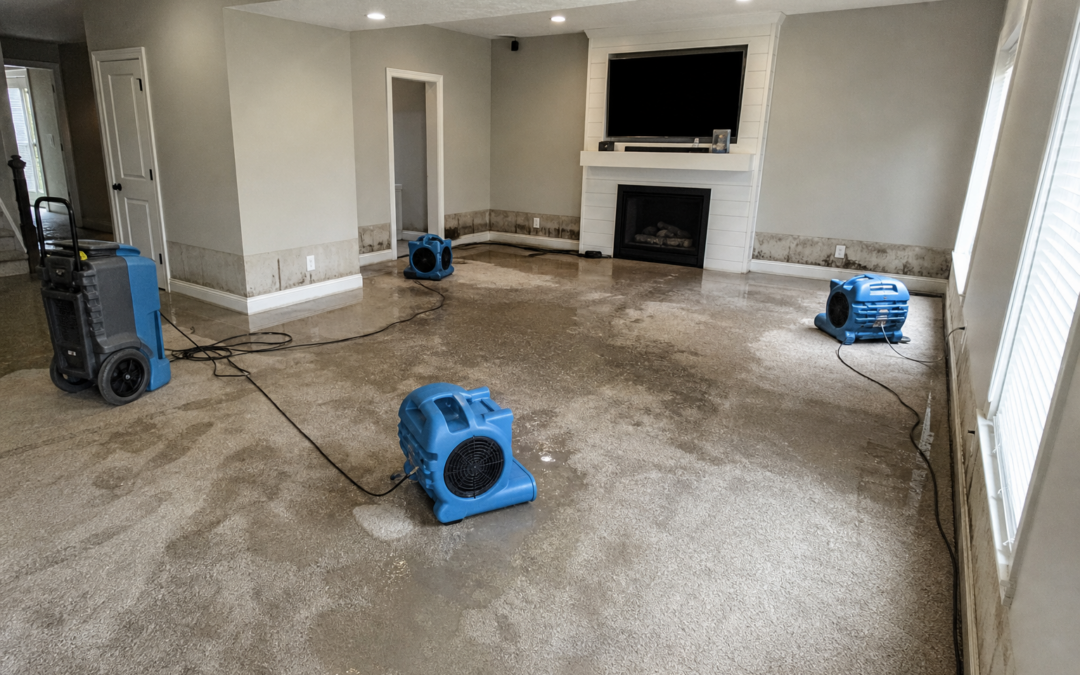
Two identical Loveland homes take on the same two inches of water. The one with an unfinished basement is a three-day drying job and a bill nobody enjoys but everyone survives. The one with a finished basement is a multi-week project involving demolition, drying, reconstruction, and a family living upstairs the whole time.
Same water. Very different outcome. Here’s why — and what actually reduces the damage.
The Problem Is What’s Behind the Finish
An unfinished basement is concrete, framing and mechanicals. Concrete is non-porous enough to clean and dry. Solid framing dries. There’s nothing hiding anything.
A finished basement puts four or five layers of absorbent material between the water and the air:
- Carpet and pad. The pad is a sponge — it holds many times its weight in water and it’s the layer sitting directly on the wet slab.
- Drywall. Gypsum wicks water upward against gravity. Two inches of standing water routinely produces sixteen to twenty-four inches of wet drywall, and it doesn’t look wet at the top.
- Insulation in the stud bays. Fiberglass holds water and stops insulating. It’s also completely hidden.
- Baseboard and trim. MDF trim swells and delaminates almost immediately. Wood trim traps water against the drywall behind it.
- Cabinetry and built-ins. Particleboard boxes in a basement bar or media wall are effectively sacrificial once they get wet.
Every one of those layers is a place water goes where air can’t follow. That’s the entire difficulty. Drying works by moving air across wet material — and a finished basement is specifically designed to prevent air from touching anything structural.
Why We Have to Open Things Up
Homeowners often ask us to just set fans in the room and let it dry. We understand the instinct, and it doesn’t work.
Air moving across the surface of a wall does almost nothing for water sitting in the cavity behind it. The room will feel dry within a couple of days while the framing, insulation and back side of the drywall stay saturated for weeks. That’s the exact condition mold needs, and it can begin within 24 to 48 hours.
So we open things strategically. Not a demolition free-for-all — targeted access based on where the moisture meters say the water actually is:
- Flood cuts — drywall removed to a line above the highest moisture reading, typically 12 to 24 inches
- Baseboard removed and small holes drilled into the base of the cavity so air can circulate inside the wall
- Wet insulation pulled — it will not dry in place at any acceptable speed
- Carpet pad removed almost always; the carpet itself is often salvageable on a clean-water loss
- Toe-kicks pulled on cabinetry so the cavity underneath can be dried
Where possible we use specialty equipment — injection drying systems and drying mats that push air into wall cavities and under hard flooring — to save materials that would otherwise have to be removed. That costs more in equipment and less in reconstruction, and on a nice finished basement it’s usually the right trade.
The Category Question Decides How Much Comes Out
How much of your finished basement survives depends heavily on what kind of water it was.
Clean water — a supply line, a water heater, a burst pipe. The most salvageable scenario. Carpet often saved, drywall sometimes dried in place, and the scope stays contained if we get there quickly.
Grey water — a washing machine discharge, a dishwasher, an overflowing sink. Some contamination. Pad goes, carpet may be cleanable, more drywall comes out.
Black water — sewer backup, or floodwater from outside. Everything porous that absorbed it comes out. Carpet, pad, drywall, insulation, particleboard, upholstered furniture. There’s no negotiating this one; it can’t be sanitized in place.
And there’s a fourth variable that matters as much as category: time. A clean-water loss discovered in an hour is a drying job. The same loss discovered after a weekend away is a demolition job, because by then the water has wicked everywhere and growth has started.
What Makes This Cheaper — Before Anything Happens
If you have a finished basement in Loveland, these are worth doing this month:
- Put leak detectors in. Inexpensive sensors near the water heater, washing machine, basement bathroom and sump pit. Some models shut off your main automatically. This is the highest-return item on the list by a wide margin — it converts a catastrophe into an inconvenience.
- Test the sump pump and add a battery backup. A pump that fails during a power outage is how most finished basements in this area get wet.
- Know where your main shutoff is and make sure it turns. Everyone in the house should know. A valve nobody can find costs you fifteen minutes, and fifteen minutes of open supply line is a lot of water.
- Replace rubber supply lines with braided stainless. Cheap, fast, and eliminates a leading cause.
- Check your water heater’s age. Over ten years and sitting in a finished basement with no pan is a bad bet.
- Fix the grade and downspouts outside. Most finished basements that get wet in Loveland get wet from the outside, not from a pipe.
- Check your sewer backup endorsement. A standard policy usually doesn’t include it, and a backup into a finished basement is one of the most expensive losses there is.
- Get contents off the floor. Shelving twelve inches up protects exactly the things that aren’t replaceable.
And in the First Hour
Shut off the water source if it’s a plumbing failure. Cut power to the area if it’s safe to do from a dry spot. Photograph everything before you move anything — this is your claim. Get furniture legs up on foil or blocks so they stop staining the carpet. Pull what you can carry out of the water.
Then call us before you call your insurance company. On a finished basement the scope is the entire argument, and the scope is determined by moisture readings. Having ours documented before the claim opens consistently produces a better outcome than filing first and measuring later.
Also: don’t wait until morning. Six hours is the difference between saving your drywall and replacing it.
Call Even If You’re Not Sure
If your finished basement has ever taken water — even if it seemed minor, even if it was a while ago — a moisture inspection is worth it. Carpet dries. What’s behind the baseboard often doesn’t. Our meters and thermal cameras answer that in minutes and the inspection is free.
Finished basement water damage in Loveland? Call Revive Restoration at (720) 340-3499 — 24/7. Family operated since 2016, owned by Levi, born and raised in Northern Colorado.
See our full Loveland water damage restoration services, or read our other Loveland guides: hail damage that becomes a roof leak, living near the Big Thompson, and what happens after you call. We also serve Berthoud, Johnstown, Windsor and Greeley — full list on our service areas page.