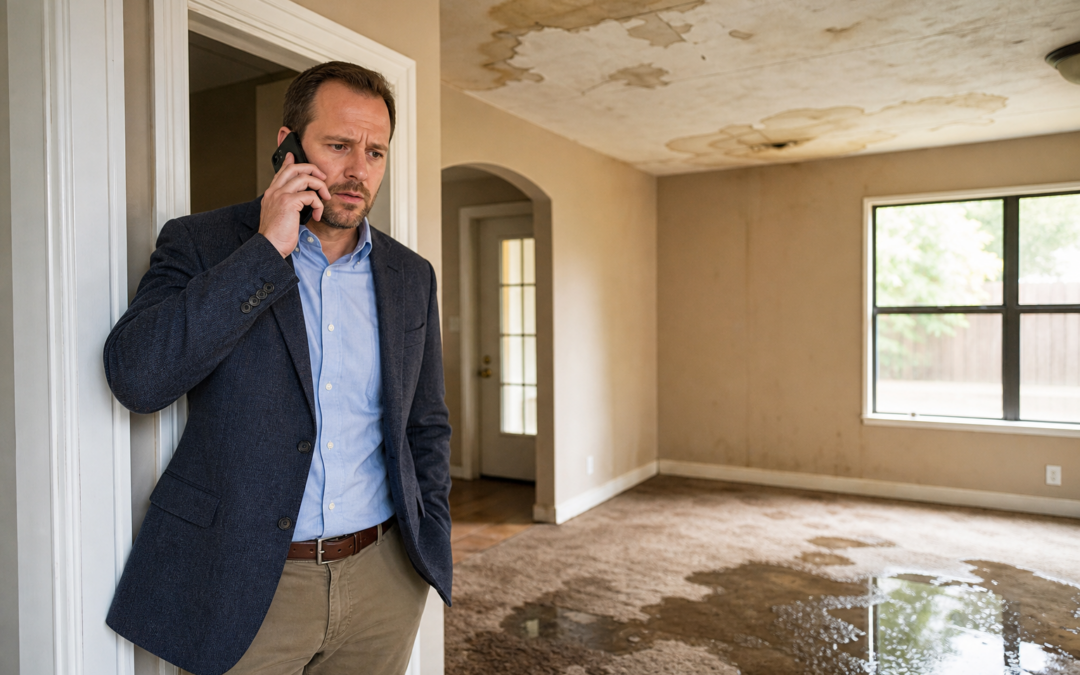
You get the call no landlord wants. Your tenant says there’s water everywhere — a pipe burst, the basement flooded, or they came home from vacation to a soaked kitchen. Now you’re juggling a dozen problems at once: the damage itself, your tenants, your insurance, potential displacement, and a property that’s losing value by the hour.
Water damage at a rental property is more complicated than at your own home. There are tenants to consider, legal obligations to meet, insurance policies that work differently than homeowner coverage, and restoration timelines that affect real people’s living situations.
If you’re a landlord in Northern Colorado — whether you own a single rental in Loveland, a duplex in Windsor, or a portfolio of properties across the Front Range — here’s your step-by-step guide for handling water damage the right way.
Step 1: Respond Immediately (Even if It’s 2 AM)
Colorado law requires landlords to maintain habitable living conditions. When water damage threatens habitability — think standing water, sewage backup, loss of heat or electricity, or mold concerns — your response clock starts immediately.
Here’s what to do the moment you find out:
- Tell your tenant to shut off the water source if possible. Walk them through finding the shutoff valve for the affected area or the main water shutoff for the property. If it’s a supply line or pipe burst, every minute counts.
- Call Revive at (720) 340-3499. Get a professional assessment and emergency mitigation started. We respond 24/7 and understand the urgency rental situations create.
- Document the initial damage. Ask your tenant to take photos and videos immediately — before anything gets cleaned up or moved. This documentation is critical for your insurance claim.
The worst thing you can do is wait until morning, wait until Monday, or tell your tenant to “just put some fans on it.” Delayed response leads to mold, expanded damage, and potentially stronger legal exposure.
Step 2: Understand Your Obligations
Colorado has clear expectations for landlords when a rental property becomes uninhabitable due to water damage.
Warranty of habitability. Under Colorado’s Warranty of Habitability statute (C.R.S. § 38-12-503), landlords must maintain rental properties in a condition fit for habitation. Water damage that affects structural integrity, creates health hazards (mold, sewage contamination), or eliminates essential services (running water, heat, electricity) triggers this obligation.
What this means in practice:
- You must begin addressing the problem promptly — not eventually
- If the unit is uninhabitable during restoration, you may need to provide alternative housing or allow the tenant to break the lease without penalty
- Tenants can request rent abatement for the period the unit is uninhabitable
- If you fail to act, tenants can pursue remedies including lease termination with penalty to the landlord
This is not legal advice — consult an attorney for your specific situation. But the general principle is clear: move fast, communicate openly, and prioritize making the property safe and livable.
Step 3: Coordinate Restoration Around Your Tenants
This is where rental property water damage gets logistically challenging. Someone lives there.
Can tenants stay during restoration? It depends on the scope. Minor water damage contained to one room — maybe. Significant damage requiring commercial drying equipment, demo of drywall, or mold remediation — usually not. Here’s what to consider:
- Safety first. If there’s any risk of mold exposure, contaminated water (Category 2 or 3), structural compromise, or electrical hazard, the tenants need to be out.
- Noise and disruption. Commercial dehumidifiers and air movers run 24/7 and are loud. Asking tenants to live with that for 3-5 days often isn’t reasonable.
- Access requirements. Restoration crews need full access to affected areas, which may include bedrooms and living spaces.
When tenants need to relocate temporarily:
- Check your landlord insurance policy for “loss of rents” coverage — many policies cover lost rental income during restoration
- Some policies include “additional living expense” coverage for tenants, but this varies
- Be upfront with your tenants about the expected timeline. We’ll give you a realistic estimate after the initial assessment
- Put any agreements about rent reduction or temporary housing in writing
Communication is everything. Tenants who feel informed and cared for during a crisis are far more likely to stay once the property is restored. Tenants who feel ignored or dismissed start looking for a new place — and possibly a lawyer.
Step 4: Navigate the Insurance Maze
Rental property water damage involves a different insurance landscape than owner-occupied homes.
Your landlord policy (dwelling/fire policy):
- Covers the structure, fixtures, and building systems
- May include loss of rents during restoration
- Typically does NOT cover tenant belongings — that’s what renter’s insurance is for
- Deductibles on landlord policies are often higher than homeowner policies
Your tenant’s renter’s insurance:
- Covers their personal property damaged by water
- May cover their temporary living expenses (hotel, short-term rental)
- They need to file their own claim separately
- Encourage all tenants to carry renter’s insurance — and consider requiring it in your lease
Why you should call Revive before calling your insurance company:
We create detailed documentation — moisture readings, thermal imaging, photo evidence, scope of damage — in the format insurance adjusters expect. This documentation strengthens your claim and reduces back-and-forth. We work with insurance carriers every day and know how to present the full scope of damage so nothing gets missed or denied.
Step 5: Prevent It From Happening Again
Once the property is restored, invest in prevention. Water damage at a rental property is expensive not just in repair costs, but in lost rent, tenant turnover, and your time.
- Inspect supply lines and water heaters annually. These are the top causes of catastrophic water damage in rental properties. Replace washing machine hoses, toilet supply lines, and water heater connections proactively.
- Install water leak sensors. Affordable smart sensors near water heaters, washing machines, and under kitchen sinks can alert you via your phone before a small leak becomes a flood. They’re especially valuable at properties you don’t visit daily.
- Maintain gutters and grading. Water intrusion through foundations is common in Northern Colorado, especially during spring snowmelt. Make sure gutters are clear and soil grades away from the foundation.
- Educate your tenants. Make sure they know where the main water shutoff is, and ask them to report any drips, stains, or musty smells immediately. A tenant who reports a small leak saves you from a massive restoration.
- Review your insurance coverage annually. Make sure your policy limits, loss-of-rents coverage, and deductibles still make sense for the property’s value and rental income.
Why Revive Is the Right Call for Landlords
We understand that landlord water damage situations come with extra layers — tenants, lease obligations, different insurance structures, and timeline pressure to get the property back online.
When you call Revive:
- We respond 24/7 — because pipes don’t only burst during business hours
- We communicate with both you and your tenants so everyone stays informed
- We document everything your insurance company needs
- We work efficiently to minimize the time your property is offline and your tenants are displaced
- We’ve handled water damage at single-family rentals, duplexes, and multi-unit properties across Northern Colorado
Call Revive at (720) 340-3499 before calling your insurance company. We’ll assess the damage, start mitigation, and help you protect your property, your tenants, and your investment.
Revive Restoration serves landlords and property managers across Northern Colorado, including Johnstown, Loveland, Windsor, Fort Collins, and the broader Front Range. Call (720) 340-3499 for 24/7 emergency water damage restoration.