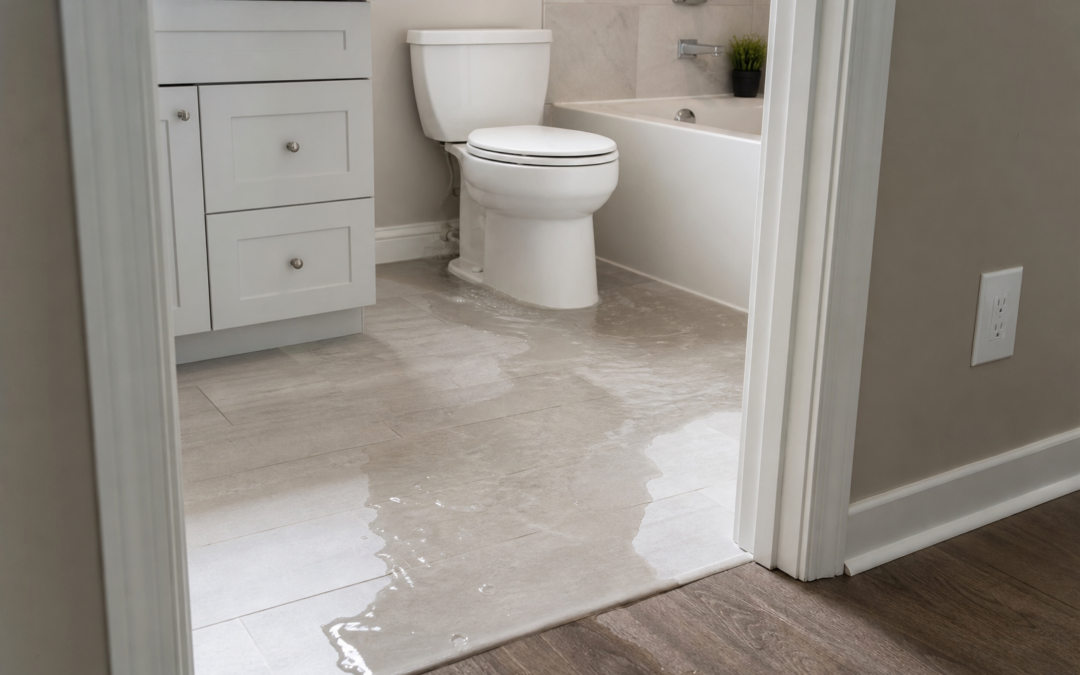
It starts with water pooling around the base of the toilet. Or you walk into the bathroom and the floor is soaked. Maybe a supply line burst behind the wall while you were at work — and now water is running down through the ceiling into the room below.
Toilet overflows and bathroom floods are one of the most common water damage emergencies homeowners face. They happen fast, they’re messy, and they’re almost always worse than they look. The water you can see on the bathroom floor is only part of the problem — because underneath that tile or vinyl, water is already spreading through the subfloor, soaking into joists, and wicking up the backside of drywall in ways you can’t see.
Here’s what to do, what not to do, and when it’s time to call a professional.
The Three Types of Bathroom Water Damage
Not all bathroom floods are equal. The type of water involved determines how serious the situation is and how it needs to be handled:
Category 1 — Clean Water. This comes from a supply line burst, a running faucet, or a tank overflow from a malfunctioning fill valve. The water itself is clean and poses no immediate health risk. But it still causes structural damage if it’s not dried properly.
Category 2 — Gray Water. This includes water from a toilet bowl overflow (without solid waste), a washing machine backup, or a shower drain overflow. It may contain bacteria, soap residue, and other contaminants. Gray water requires cleaning and antimicrobial treatment — you can’t just mop it up.
Category 3 — Black Water. This is a sewage backup or a toilet overflow that involves solid waste. It’s a health hazard. Black water contains harmful bacteria, viruses, and pathogens. Any materials it contacts — carpet, drywall, insulation — typically need to be removed and replaced, not just dried. Do not attempt to clean Category 3 water yourself.
Why Bathroom Water Damage Is Worse Than It Looks
Here’s what most homeowners don’t realize: tile and vinyl flooring are not waterproof barriers. They’re water-resistant on the surface, but water finds its way through grout lines, seams, edges along the vanity, and gaps around the toilet flange. Once it’s past the surface, it hits the subfloor — and that’s where the real damage begins.
- Subfloor absorption. Plywood and OSB subflooring absorb water quickly. A toilet overflow that sits for even an hour can saturate the subfloor in a radius well beyond the visible water on the surface.
- Joist and framing damage. If the bathroom is on an upper floor, water travels down through the subfloor and along joists, dripping into the ceiling cavity below. You might not see a stain on the ceiling below for hours or even days — but the damage is already happening.
- Wicking behind walls. Drywall acts like a sponge from the bottom up. Water that pools at the base of a wall gets drawn upward through capillary action, often reaching 12 to 18 inches above the visible water line. Behind the drywall, insulation traps moisture and creates a perfect environment for mold.
- Mold risk. In warm, humid conditions — like a bathroom that stays damp after a flood — mold can begin growing on subfloor and framing in as little as 24 to 48 hours. And you won’t see it. It’s under the floor, behind the walls, inside the ceiling below. By the time you smell it, it’s already established.
What to Do Immediately
If your bathroom is flooding or you’ve discovered water damage from a toilet overflow:
1. Shut off the water. For a toilet overflow, turn the shutoff valve at the base of the toilet clockwise until it stops. If you can’t find the valve or it won’t turn, shut off the main water supply to the house. Stopping the flow is step one.
2. Don’t flush. If the toilet is overflowing, do not try to flush it again. This is one of the most common mistakes — and it makes the flood worse instantly.
3. Remove standing water carefully. Use towels to soak up what you can on the surface. But understand that this addresses only the visible water — the real problem is what’s already soaked below the flooring.
4. Call Revive Restoration — before you call insurance.
Your restoration team should be your first call. We know exactly what documentation your adjuster needs, and we start emergency mitigation right away — which your insurance policy requires. We’ll assess the full scope of damage using moisture meters and thermal imaging so nothing gets missed.
Call us at (720) 340-3499 — 24/7 emergency response across Northern Colorado.
5. Document everything. Before you clean up, photograph every affected area. The water on the floor, the toilet, any visible damage, any water coming through the ceiling below. Your insurance company needs to see the full picture.
6. Do not use a household vacuum on sewage water. If the overflow involved any solid waste or sewage backup, do not attempt to clean it yourself. Category 3 water requires professional extraction, disposal, and antimicrobial treatment. It’s a health risk.
The Hidden Mold Risk
Bathroom floods are one of the most common causes of hidden mold in homes. Here’s why:
Bathrooms are already the most humid rooms in the house. When a flood happens, moisture levels spike in enclosed spaces — under the vanity, behind the toilet, inside the wall cavity, under the floor. These spaces have poor airflow and stay damp long after the visible water is gone.
Mold spores are everywhere — they’re naturally present in the air. All they need to colonize is moisture, warmth, and an organic surface (like wood subfloor or paper-faced drywall). A bathroom flood gives them all three.
The danger is that mold can grow for weeks behind walls and under floors before anyone notices. By then, remediation is more extensive and more expensive than it would have been if the moisture had been addressed within the first 24 to 48 hours.
This is exactly why professional moisture assessment matters after any bathroom flood — even one that “didn’t seem that bad.”
When to Call a Restoration Pro vs. Handle It Yourself
Here’s a simple threshold:
- If the water was contained to the surface of the floor, was clean water (Category 1), and you dried it within an hour — you may be fine handling it yourself. But check for any moisture under the floor or in the ceiling below within the next few days.
- If water sat for more than an hour, involved gray or black water, reached walls or the ceiling below, or you’re not sure how long it was there — call a restoration professional. The risk of hidden damage and mold growth is too high to guess.
At Revive, we do free inspections. We’ll bring moisture meters and thermal cameras, tell you exactly what we find, and give you an honest assessment of whether you need restoration work. No pressure, no surprises.
We Handle Bathroom Water Damage — From Emergency to Rebuild
At Revive Restoration, bathroom floods are one of our most common calls across Northern Colorado. We’ve seen everything — from minor overflows caught in minutes to major sewage backups that require full subfloor and drywall replacement. We respond fast, we work directly with your insurance company, and we handle the complete restoration so you’re not juggling multiple contractors.
Revive Restoration — (720) 340-3499 — 24/7 Emergency Response Across Northern Colorado
Serving Fort Collins, Loveland, Windsor, Johnstown, Greeley, and the broader Front Range.