You walk into your kitchen and feel it before you see it — the hardwood floor is soft, the boards are lifting at the edges, and there’s a faint smell of dampness in the air. Whether it’s a burst pipe, a dishwasher leak, a basement flood, or storm water that found its way inside, one of the first questions every homeowner asks is the same: can my hardwood floors be saved?
The answer is: it depends — and timing is everything. Here’s what Northern Colorado homeowners need to know about water damage and hardwood floors, including what to watch for, when there’s still hope, and when it’s time to call in a professional.
What Happens to Hardwood Floors When They Get Wet
Wood is a natural material, and it reacts to moisture immediately. When water reaches your hardwood floors, a few things start happening right away:
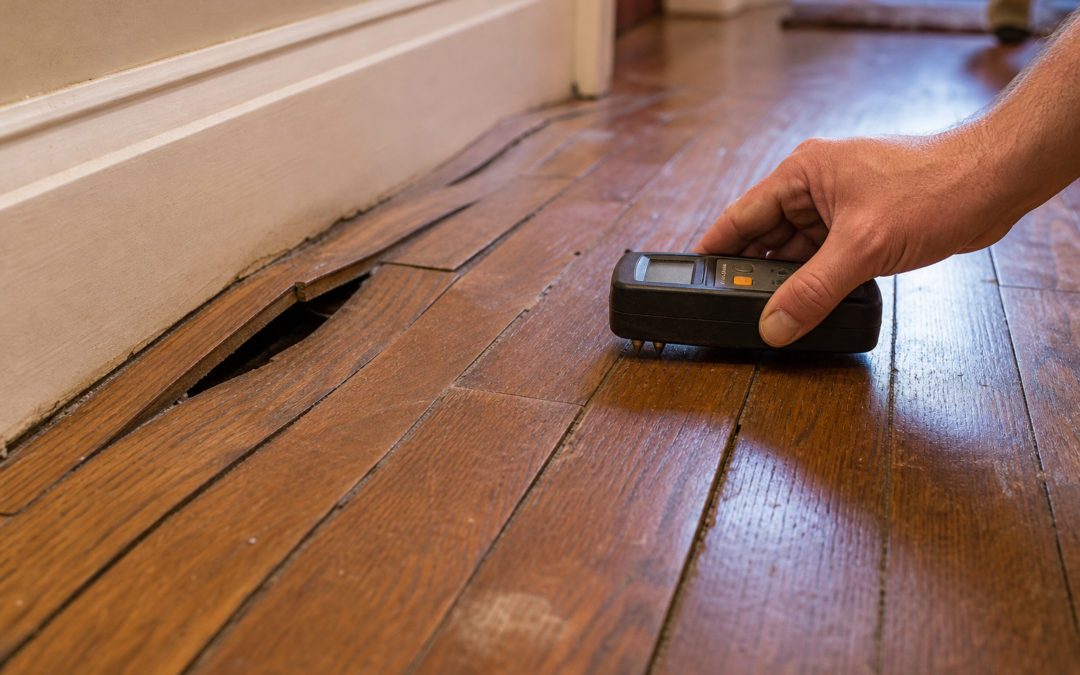
- Cupping. The edges of individual boards start to curl upward while the center stays lower. This happens because the bottom of the board absorbs moisture faster than the top, creating uneven expansion.
- Warping and buckling. As more moisture is absorbed, boards can warp out of place entirely — lifting off the subfloor and creating a visible “tent” effect. This is more severe and harder to reverse.
- Crowning. If the floor is dried too quickly or unevenly after cupping, the center of the board can push higher than the edges — the opposite of cupping. This is why professional drying matters.
- Subfloor saturation. Beneath your hardwood is a subfloor — usually plywood or OSB. If water reaches the subfloor and stays there, it can swell, weaken, and develop mold growth that’s completely invisible from above.
- Staining and discoloration. Tannins in wood react with water and minerals, causing dark stains that can be difficult or impossible to sand out.
The 48–72 Hour Window
This is the most important thing to understand: you have roughly 48 to 72 hours to begin professional drying before the damage becomes irreversible.
Within the first 24 hours, most hardwood floors can still be saved if water is extracted and drying begins immediately. Between 24 and 72 hours, the odds start dropping — but professional equipment can still make a difference in many cases. After 72 hours of standing water or sustained moisture, the likelihood of saving the original flooring drops significantly. Mold may have started growing on or beneath the subfloor, and the wood may be permanently deformed.
The takeaway: don’t wait to see if the floors “dry on their own.” They won’t — not fast enough to prevent lasting damage.
Why Fans and Dehumidifiers From the Hardware Store Won’t Cut It
We get it — when water hits your floors, the instinct is to grab every fan you own, buy a dehumidifier from the big box store, and try to dry things out yourself. Unfortunately, household equipment almost never works fast enough to save hardwood floors. Here’s why:
- Residential fans move air across the surface — but the moisture is trapped inside and underneath the wood. Surface airflow alone doesn’t reach the subfloor or the bottom of the boards.
- Consumer dehumidifiers remove moisture from the air, but they can’t pull moisture out of wood and subfloor materials at the rate needed to prevent permanent damage.
- Without moisture monitoring, you have no way to know whether the floor is actually drying or whether moisture is still trapped beneath the surface. “It looks dry” and “it is dry” are two very different things.
What Professional Drying Actually Looks Like
When Revive Restoration arrives to assess water-damaged hardwood floors, we use a completely different set of tools and techniques than what’s available at a hardware store:
- Moisture meters and thermal imaging. Before we touch anything, we map exactly where moisture is — in the wood, in the subfloor, in the walls. This tells us what we’re dealing with and how aggressive the drying plan needs to be.
- Floor drying mat systems. These specialized mats sit on top of the hardwood and apply controlled vacuum pressure and heat to pull moisture out of the wood and subfloor without over-drying or causing crowning. This is the gold standard for hardwood floor drying.
- Commercial air movers and dehumidifiers. Industrial-grade equipment creates a controlled drying environment across the entire affected area — not just the spots you can see.
- Daily monitoring. We check moisture levels every day and adjust equipment placement, airflow, and dehumidification as the drying progresses. This prevents secondary damage like crowning, cracking, or mold.
How to Know If the Subfloor Needs Replacement
Even if the hardwood itself can be dried and saved, the subfloor underneath may need to be replaced. Here are the signs:
- The subfloor feels soft or spongy when you walk on it — even after the surface appears dry.
- There’s visible mold on the subfloor when boards are lifted for inspection.
- Moisture readings remain elevated after several days of professional drying — indicating the subfloor material has broken down and is holding water permanently.
- OSB (oriented strand board) was used as the subfloor. OSB swells significantly when wet and often cannot return to its original shape, unlike plywood which handles moisture somewhat better.
Revive’s team assesses the subfloor as part of every hardwood floor drying project. If replacement is needed, we coordinate the full scope — from subfloor removal and mold treatment to new subfloor installation and flooring coordination.
Think Your Floors Might Be Salvageable? Call Revive.
If you’ve got water on your hardwood floors — or you recently had water and the floors don’t look right — don’t assume the worst, but don’t wait either. The sooner a professional assesses the damage and starts drying, the better your chances of saving the original flooring.
Call Revive Restoration at (720) 340-3499 for a free assessment. We’ll tell you honestly whether your floors can be saved — and if they can, we’ll get to work immediately. We respond 24/7 across Northern Colorado.
Call Revive BEFORE calling your insurance company. We document the damage properly and communicate directly with your adjuster, making the entire claims process smoother for you.