Johnstown has changed fast. Between Thompson River Ranch, Ledge Rock, Rocksbury Ridge, and the corridor along I-25, thousands of homes have gone up in a town that used to be measured in blocks. It is a great place to live — and it is also a place where a lot of homeowners are living in their first house with a basement, in a neighborhood where the storm drainage is still catching up to the pace of development.
If water is in your Johnstown home right now, call Revive Restoration at (720) 340-3499. We are local to Northern Colorado, we answer 24/7, and we are usually on site within 60 minutes. Call us before you call your insurance company so the damage gets documented properly from the start.
Johnstown’s water damage risk factors
Rapid new-build growth. New subdivisions mean new grading, new swales, and new storm systems that have not yet been tested by a real Front Range cloudburst. The lowest lot on a new street usually finds out first.
Finished basements everywhere. Almost every newer Johnstown home has a basement, and a large share of them are finished or in the middle of being finished. Carpet, drywall, and stored belongings are what turn a modest amount of water into an expensive loss.
Drainage still catching up. Development in the Johnstown and Milliken area has outpaced infrastructure in places. Add irrigation ditches, the Little Thompson River, and heavy summer runoff, and low-lying areas can take on water quickly during a storm.
Appliance and supply-line failures. Homes built in the last five to ten years are hitting the age where builder-grade supply lines, water heaters, and washing machine hoses start to fail. These do not care about the weather.
Freeze-thaw damage. Northern Colorado swings hard between warm afternoons and freezing nights. Exterior spigots, unheated garage walls, and crawl space plumbing are the usual casualties. Our frozen pipe prevention guide is worth ten minutes before winter.
The calls we get most often in the area
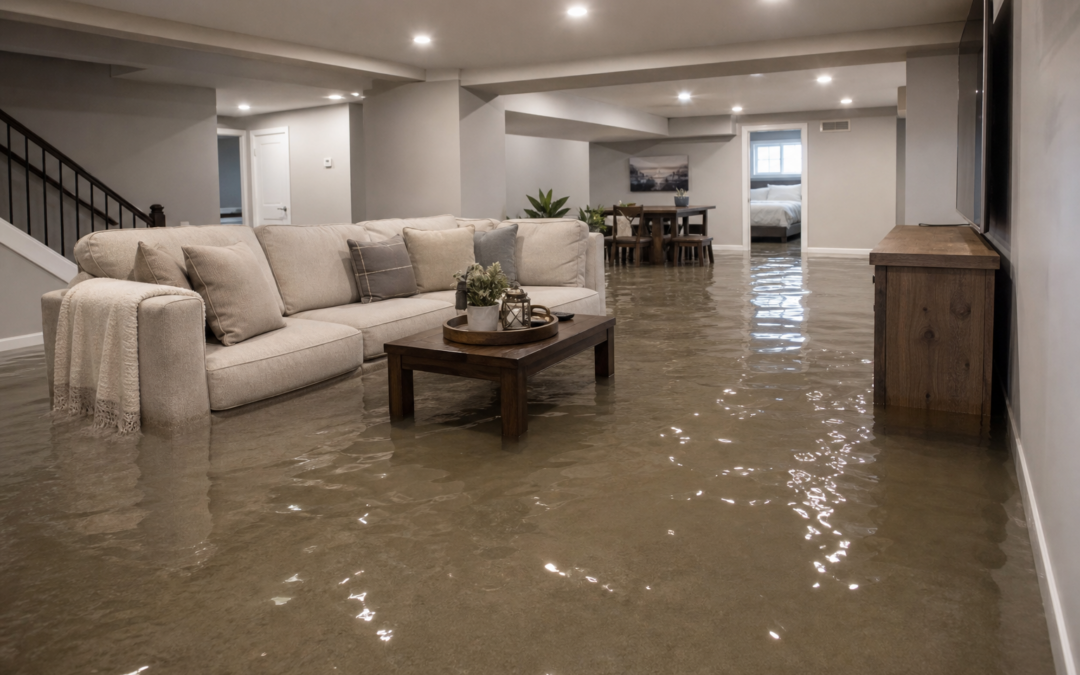
Basement flooding after heavy rain leads the list, followed by appliance leaks and sump pump failures. The third category is the slow one — a supply line weeping behind a wall, a toilet seal failing gradually, or a crawl space that has been damp for months. Those cause the most damage per gallon precisely because nobody notices them.
The common thread: visible water is only part of the story. Drywall wicks moisture upward, insulation holds it, and framing and subfloor stay wet long after the surface feels dry. That trapped moisture is what causes mold, warped floors, and smells that never quite go away — and mold can start within 24 to 48 hours.
What the restoration process looks like
Emergency response. We stop the source, check for electrical hazards, and extract standing water with truck-mounted equipment.
Moisture mapping. Thermal cameras and moisture meters show exactly where the water traveled, including inside wall cavities and under cabinets and flooring. This becomes the documentation your adjuster needs.
Structural drying. Commercial air movers and dehumidifiers, positioned deliberately, with readings logged daily. We remove only what cannot be saved — saving your cabinets and hardwood is better for you and for your claim.
Verification. We confirm your home is dry with instruments, not by how it looks or feels.
Repair and rebuild. Drywall, trim, paint, and flooring, back to the way it was.
Typical residential jobs involve three to five days of drying. Category 3 water — sewage or ground-contaminated water — requires more containment and takes longer.
We cover Johnstown, and we are close by
Revive Restoration serves Johnstown, Milliken, Loveland, Greeley, Windsor, Fort Collins, and the broader Front Range. We are a local company, not a franchise routing your emergency through an out-of-state call center. When you call at 2 a.m., you get someone who knows where Thompson River Ranch is.
Call Revive before you call insurance
This is the single most useful thing we tell homeowners. Insurance claims are won and lost on documentation. When you call us first, we arrive, inspect at no charge, map the moisture, photograph everything, and write a scope — and then you call your carrier with facts. We work with every major insurer in Colorado and will talk to your adjuster directly.
What to do in the first ten minutes
Shut the water off at the main. Stay out of standing water near outlets or the electrical panel. Move what you can to a dry area. Photograph everything before you move it. Do not try to dry a soaked basement with household fans — it moves air over the surface and leaves the structure wet underneath.
Johnstown homeowners: call Revive Restoration at (720) 340-3499. 24/7 emergency response, free inspection, and a local crew that will be there fast.