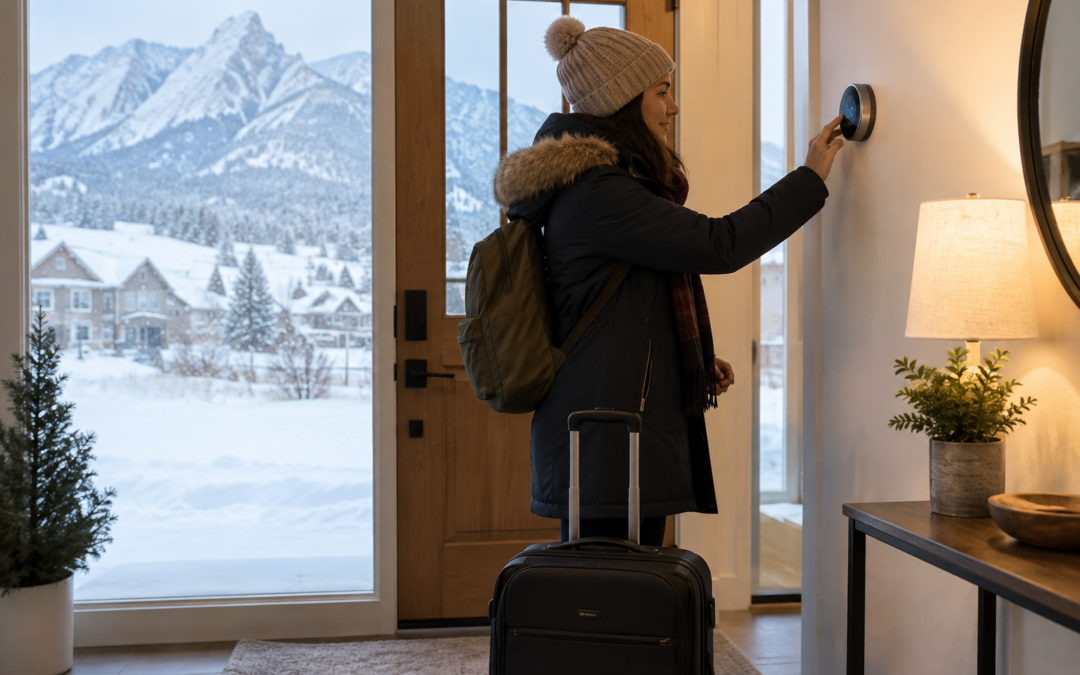
Whether you’re heading to Arizona for the winter, visiting family over the holidays, or just taking a two-week ski trip, the moment you lock the door your home is on its own. In a Colorado winter, that matters.
Every winter we get calls from Northern Colorado homeowners who came back to a nightmare: a pipe burst on a below-zero night, and water ran for days with nobody there to shut it off. The good news is that most of these disasters can be prevented with an hour of prep before you leave.
Here’s a winter travel checklist for homeowners in Johnstown, Loveland, Windsor, Fort Collins, Greeley and across the Front Range.
Why an Empty House Is at Risk in Winter
When you’re home, you’d notice a drip, a cold room or a strange sound within hours. When you’re gone, a small problem gets days or weeks to grow. A burst supply line can release a huge amount of water every hour. Over a long trip, that’s enough to flood a basement, ruin floors and drywall on several levels, and give mold weeks to grow.
Colorado’s sudden cold snaps make it worse. A mild week can turn into a subzero night with little warning, and that’s when pipes in exterior walls, crawlspaces and garages freeze and split.
Before You Leave: Water Shutoff and Draining
- Find your main water shutoff and make sure it actually turns. It’s usually in the basement or crawlspace where the line enters the house, or in a curb box near the street.
- Shut off the main water for longer trips. If nothing is pressurized, very little can leak.
- Drain the lines. After shutting off the main, open the lowest faucet and the highest faucet in the house to let the pipes empty.
- Turn your water heater to “vacation” or pilot mode (or shut it off if you’ve drained the system, following the manufacturer’s instructions).
- Check fire sprinkler systems first. If your home has a fire sprinkler system on the domestic water line, talk to a plumber before shutting off the main.
- Disconnect garden hoses and make sure outdoor spigots and the sprinkler system were winterized and blown out.
- Turn off water to the washing machine and the fridge ice maker at their supply valves, even if you leave the main on.
Thermostat and Heat Settings
- Keep the heat on. Never turn the furnace off in winter. Most plumbers and insurers recommend keeping the thermostat at about 55°F or higher while you’re away.
- Open cabinet doors under sinks on exterior walls so warm air reaches the pipes.
- Leave interior doors open so heat circulates to every room.
- Replace the furnace filter and get a tune-up before a long trip. A furnace that quits while you’re gone is how pipes freeze.
- Use a smart thermostat that alerts your phone if the temperature drops or the furnace stops.
- Put fresh batteries in the thermostat if it uses them.
Who Should Check on the House
Even with good prep, nothing beats a person walking through. Ask a trusted neighbor, friend or house-sitter to:
- Come by at least once a week, and after any hard freeze or big storm
- Walk every floor, including the basement and the utility room
- Check that the house feels warm and the furnace is running
- Look under sinks and around the water heater, washer and toilets
- Look up at ceilings for stains, and at the roof edge for big ice buildup
- Have your number, and ours, in case they find water
Check your insurance policy, too. Some homeowners policies limit coverage for freeze damage if a home is left vacant or unheated for a long stretch without proper precautions. Call your agent before a long trip to find out what your policy expects.
Low-Tech and High-Tech Helpers
- Smart leak detectors under sinks, by the water heater and next to the washer send an alert the second they get wet.
- An automatic water shutoff valve can turn off the main by itself when a sensor detects a leak.
- Wi-Fi temperature sensors warn you if the house is getting too cold.
- The “cup and coin” trick for chest freezers: freeze a cup of water, put a coin on top, and if the coin has sunk when you get back, the power was out long enough to thaw.
What a Burst Pipe Looks Like After Two Weeks Away
We don’t say this to scare you. We say it because we see it. When a pipe bursts in an empty house, here’s what’s typically waiting:
- Standing water in the basement and sagging, collapsed ceilings below the burst
- Saturated drywall, insulation and carpet throughout the affected floors
- Swollen hardwood and cabinets, and wet subfloor
- Visible mold already growing. Mold can start within 24 to 48 hours, so two weeks is plenty of time.
- A high indoor humidity that damages furniture, electronics and belongings in rooms the water never touched
If You Come Home to Water
- Shut off the main water right away.
- Stay out of standing water if outlets or appliances may be under it. Turn off power at the breaker if you can do it from a dry spot.
- Take photos and video of everything before you move or clean anything.
- Call Revive before you call your insurance company.
Call Revive Before You Call Insurance
After a burst pipe in an empty house, the claim will hinge on when the leak started, how far the water went, and whether the home was properly cared for. Calling Revive first means a professional documents the damage with moisture readings, thermal imaging and photos, and starts water extraction and drying right away. That record helps your adjuster see the full picture. We work with every insurance carrier.
Revive Restoration is family-owned and based in Johnstown, and we’ve been restoring Front Range homes since 2016. We answer 24/7, holidays included, and the inspection is free.
Came home to water? Call Revive Restoration at (720) 340-3499 before you call your insurance company.
Winter Travel FAQs
What temperature should I leave my house at in winter while I’m away?
Most plumbers and insurers recommend keeping the thermostat at about 55°F or higher. Never turn the heat off completely in a Colorado winter, because pipes in exterior walls and crawlspaces can freeze even when the rest of the house feels fine.
Should I turn off my water when I leave for winter?
Yes, for any trip longer than a few days, shutting off the main water and draining the lines is one of the best ways to prevent a flood. If your home has a fire sprinkler system tied to the water supply, check with a plumber first.
How often should someone check my house while I’m on vacation?
At least once a week, and after any hard freeze or major storm. They should walk every floor, including the basement, check that the heat is running, and look for water around fixtures, appliances and ceilings.
Does insurance cover a burst pipe if I was out of town?
Often, yes, if you took reasonable steps like keeping the heat on. But some policies limit freeze coverage for homes left vacant or unheated for long periods. Read your policy or call your agent before you leave, and get the damage professionally documented if it happens.
What should I do if I come home to a burst pipe?
Shut off the main water, stay clear of standing water near electricity, take photos and video of everything, and call Revive Restoration at (720) 340-3499 before you call your insurance company. Fast extraction and drying limit the damage and the mold.
Related reading: how to winterize your home before the first freeze, came home to water damage after vacation, and how to document water damage for your insurance claim.
Serving All of Northern Colorado
We handle burst pipe and frozen pipe water damage in Johnstown, Loveland, Windsor, Fort Collins, Greeley, Timnath, Berthoud, Eaton, Wellington, and Erie. See every community we serve on our service areas page, or learn more about our water damage restoration and mold remediation services.