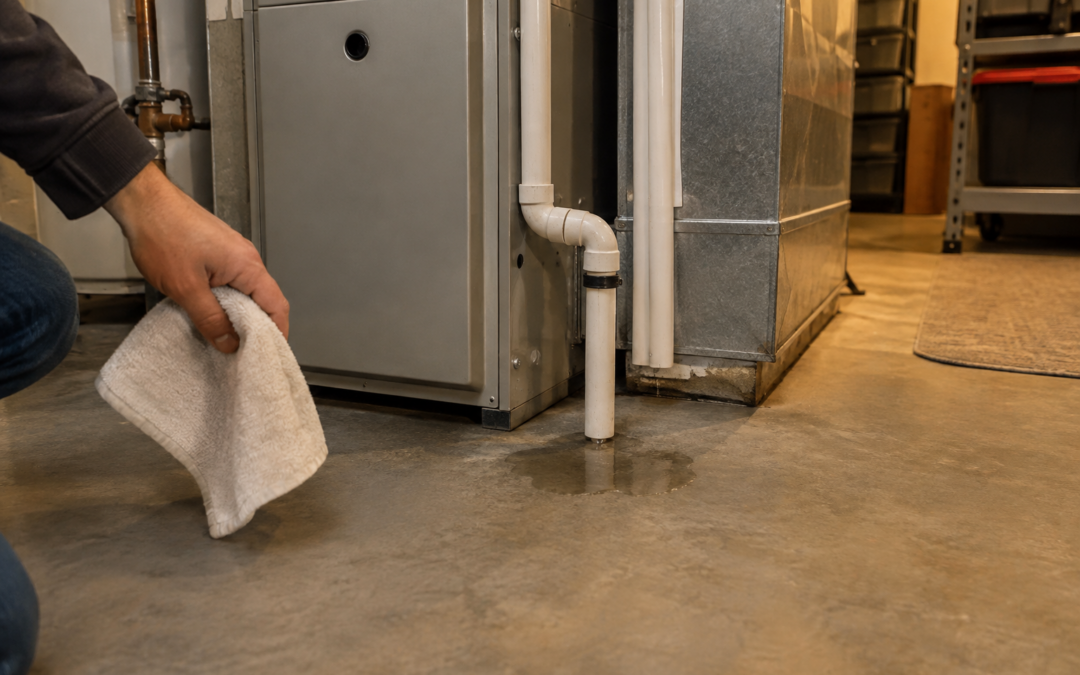
You turn the heat on for the first cold night of fall and everything seems fine. Then a week later you find a puddle on the basement floor next to the furnace. Furnaces run on gas, not water, so where’s it coming from?
If you have a high-efficiency furnace, which many homes across Northern Colorado do, the answer is almost always the condensate drain system. It’s one of the most overlooked causes of winter water damage. Because furnaces usually sit in basements and utility closets nobody looks at, a small leak can soak carpet, drywall and subfloor for weeks before anyone notices.
Why Is My Furnace Leaking Water?
High-efficiency furnaces (usually rated around 90% efficiency or higher) pull so much heat out of the exhaust that the water vapor in it condenses into liquid. That water, called condensate, drains away through a small PVC line. Often a little pump moves it to a floor drain or a utility sink.
When any part of that system fails, the water ends up on your floor instead. The most common causes:
- Clogged condensate line. Algae, sludge and debris build up inside the drain line over time and block it.
- Failed condensate pump. If your furnace uses a pump, a bad float switch or a burned-out motor means the reservoir overflows.
- Disconnected or cracked drain line. Lines get bumped during storage shuffling or other work, and fittings can work loose.
- Frozen drain line. If the line runs outdoors or through a cold crawlspace or garage, it can freeze on a hard Colorado night and back up.
- Cracked secondary heat exchanger or collector box. This is less common, but it’s a job for an HVAC technician.
- Humidifier problems. A whole-house humidifier mounted on the furnace has its own water line and drain, and those leak too.
- It’s actually the water heater. Furnaces and water heaters often sit side by side. Check which one the water is really coming from.
Older standard-efficiency furnaces don’t normally produce condensate. If one of those is leaking, have a technician check the venting, the humidifier or the AC coil sitting on top of it.
Quick Checks Before You Call Anyone
Here’s what you can safely look at yourself:
- Find the source. Dry the floor with a towel and watch where fresh water appears: the furnace cabinet, the drain line, the pump, the humidifier, or the water heater next door.
- Check the condensate pump. It’s usually a small box with a reservoir near the base of the furnace. If it’s full and not running, check that it’s plugged in and that the outlet works.
- Look at the drain line. Follow the white PVC line from the furnace to where it ends. Look for loose fittings, cracks or kinks.
- Check the filter. A badly clogged filter won’t cause a leak on its own, but it can strain the system and cause other problems. Change it if it’s dirty.
- Feel for wet materials nearby. Press on carpet, check the bottom of drywall and look at the edge of any wood subfloor.
Safety first: if the water is near electrical outlets or the furnace’s wiring, turn off power to the furnace at its service switch or breaker before you get close. If you smell gas, leave the house and call your gas utility from outside.
When a Furnace Leak Becomes a Restoration Job
An HVAC tech can fix the furnace. But if the water has been leaking for a while, the furnace isn’t the only thing that needs help. Call a restoration company if you notice:
- Wet carpet or carpet pad around the utility room, especially in a finished basement
- Swollen or stained baseboards and drywall that’s soft at the bottom
- Warped laminate or wood flooring
- A musty smell in the basement or utility closet
- Any visible mold on drywall, framing or stored boxes
- A leak you can’t date. If you don’t know how long it’s been going, assume the water has spread further than you can see.
Water wicks up drywall and spreads under flooring. Mold can begin growing on wet materials in 24 to 48 hours, and a furnace closet is warm, dark and full of moving air. Those are perfect conditions for mold.
Prevent It Next Winter
- Get a yearly furnace tune-up in the fall and ask the technician to flush the condensate line and test the pump.
- Add a water leak sensor on the floor next to the furnace and water heater so you get an alert the moment water shows up.
- Keep stored items off the floor of the utility room so a small leak doesn’t ruin them.
- Protect drain lines from freezing if any part runs through an unheated space.
Call Revive Before You Call Insurance
Insurance adjusters look closely at slow leaks. They’ll want to know what failed, when it started, and how far the water went. If you call Revive first, we measure moisture in the floor and walls, document everything with photos and readings, and start drying right away. Your claim starts with facts instead of guesses.
We’re a family-owned restoration company based in Johnstown, and we’ve served the Front Range since 2016. We work with every insurance carrier, answer 24/7, and the inspection is free.
Found water by your furnace? Call Revive Restoration at (720) 340-3499 before you call your insurance company.
Furnace Leak FAQs
Is it normal for a furnace to leak water?
It’s normal for a high-efficiency furnace to produce water, but not to leak it. The condensate should drain away through a PVC line or pump. Any water pooling on the floor means something in that drain system has failed.
Can I still run my furnace if it’s leaking water?
If it’s a small condensate leak and the furnace is otherwise running normally, you can usually run it briefly while you wait for a technician, with towels or a pan in place. If water is near wiring, the furnace keeps shutting off, or you smell gas, turn it off and call a pro. Many high-efficiency furnaces shut themselves off when the drain backs up.
How do I unclog a furnace condensate line?
Many homeowners clear minor clogs by flushing the line with a mix of warm water and a little vinegar, or by using a wet/dry vacuum at the drain end. If you’re not comfortable doing that, or the line keeps clogging, have an HVAC technician clean it and check the pump during a tune-up.
Does homeowners insurance cover water damage from a furnace leak?
Many policies cover sudden and accidental water damage, but they may not cover damage from a slow, long-term leak or the repair of the furnace itself. Every policy is different. Getting the damage professionally documented right away gives you the best shot at a fair claim.
How do I know if a furnace leak caused hidden water damage?
Look for soft or stained drywall, swollen baseboards, damp carpet pad, warped flooring or a musty smell near the utility room. A restoration professional can use moisture meters and thermal imaging to find water you can’t see. Call Revive at (720) 340-3499 for a free inspection.
Related reading: water heater leaks, how AC units cause hidden water damage, and signs of a slow leak behind your walls.
Serving All of Northern Colorado
We dry out furnace and utility-room leaks in Johnstown, Windsor, Loveland, Fort Collins, Greeley, Milliken, Firestone, Frederick, Mead, and Evans. See every community we serve on our service areas page, or learn more about our water damage restoration and mold remediation services.