
Old Town is the reason a lot of people move to Fort Collins. Brick and stone, real porches, mature trees, houses built when craftsmen expected their work to outlive them. A significant share of the housing stock west and north of College predates 1940.
We love these houses. We also spend a lot of time in their basements, because a hundred-year-old home fails in ways a new build simply doesn’t — and it needs to be dried differently when it does.
What’s Actually Behind Those Walls
Galvanized supply pipe
Homes plumbed before roughly 1960 typically used galvanized steel — steel coated in zinc. The zinc erodes over decades, then the steel corrodes from the inside out.
You feel it before you see it: the interior diameter narrows with rust, so upstairs pressure fades year over year. Then the pipe wall thins until it fails, and because the line is pressurized, the failure isn’t gentle. A pinhole opens, the escaping water erodes the weakened metal around it, and within hours you have a genuine flow inside a wall cavity.
Galvanized has a practical life of 40 to 70 years. In an Old Town home, original galvanized is well past its warranty.
Cast iron drains
The waste side corrodes from within too, but fails quietly — seepage at cracked joints, usually inside a wall or beneath the floor, wetting framing for months without a single dramatic moment. This is the one that turns up as a mold discovery during a kitchen remodel.
Foundations from before waterproofing existed
Stone, rubble and early poured foundations were built without membrane, without vapor barrier and without a perimeter drain. They’ve also had a century of soil movement. Look for efflorescence — white chalky mineral residue on the basement wall. It means water is moving through the masonry, whether or not you’ve ever seen a puddle.
Layers of well-meant remodeling
Most Old Town homes have been renovated repeatedly. We routinely open a wall and find four eras of plumbing spliced together, a 1970s bathroom stacked over original framing, or a basement finished in the 80s with paneling fastened straight to masonry. Every transition between eras is a place water gets in and a place it hides.
Plaster Is Not Drywall, and It Matters
This is where an inexperienced crew does real damage to an Old Town house.
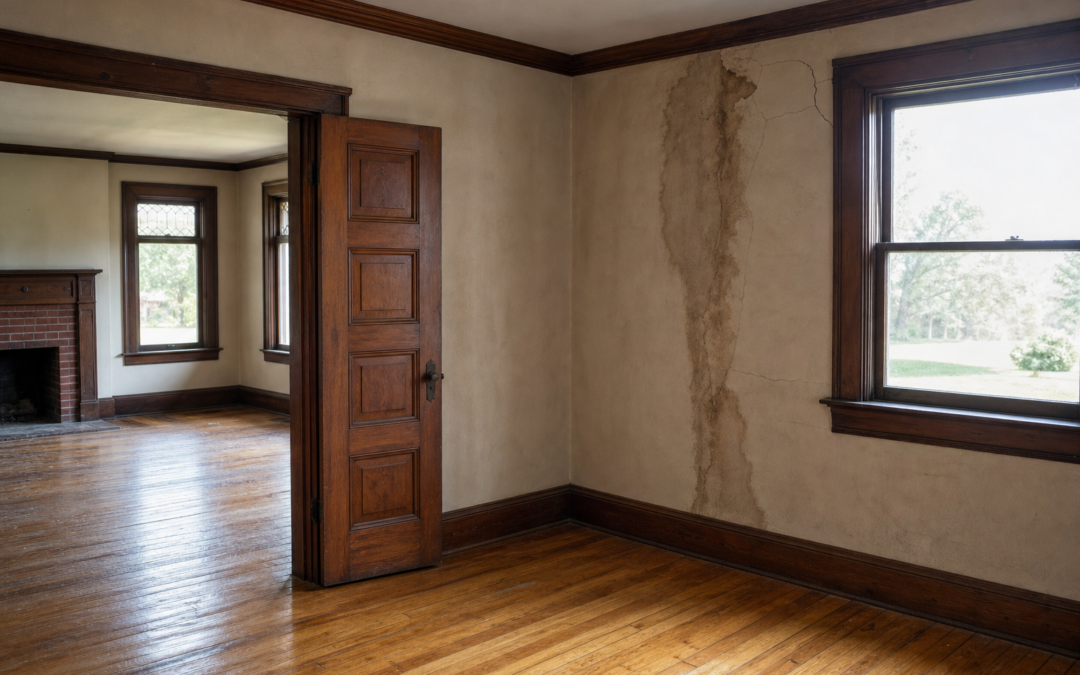
Modern drywall is predictable: it wicks, it’s cheap, and cutting it out is often the right call. Plaster over wood lath behaves completely differently. It’s dense, it holds moisture deep in the mass, and it dries far more slowly — meaning a surface reading can look fine while the wall is still wet inside. You need penetrating meters and patience, not a quick surface check and a signature.
It is also, functionally, irreplaceable. You can’t buy 1915 plaster back. Once a crew tears out an original plaster wall with hand-troweled texture and period trim, that character is gone permanently, and it was very likely a substantial part of why you bought the house.
The same goes for original hardwood over plank subfloor. Old-growth flooring is dimensionally different from anything milled today, and it often can be dried in place with mat systems rather than pulled — but only if someone bothers to try.
Our approach on historic homes is to dry in place wherever the readings permit, take more readings over more days than we would on a new build, and open only what the numbers say must be opened. It takes longer. It’s the right call on a house like this.
The Rental Layer
Renters occupy about 48% of occupied housing units in Fort Collins, and CSU enrolled 34,412 students in fall 2025. A large share of Old Town’s older homes are rentals or have been converted to units.
That creates a specific failure mode we see constantly: the person who discovers the leak has no authority to fix it. A tenant texts a property manager on a Friday night, gets a reply Monday, and water has been running through century-old framing for sixty hours. On a modern house that’s expensive. On a plaster-and-lath house with original floors, that’s the difference between drying and gutting.
If you’re a tenant: report it in writing immediately — text or email, so it’s timestamped — photograph everything, and know you can call us for an assessment yourself.
If you own or manage Old Town rentals: give tenants a number to call at 2 a.m. The cost of an unnecessary call-out is trivial against the cost of a weekend of unnoticed water in a historic house.
What’s Worth Doing, In Order
- Replace every rubber supply line with braided stainless. Toilets, sinks, the washing machine. Cheapest, fastest, highest-value item here.
- Install water leak detectors near the water heater, washer, and any basement bathroom. Some shut off the main automatically. On a historic home this is exceptional value.
- Locate your main shutoff and confirm it turns. Old valves seize. Finding that out during an emergency is a bad time.
- Check the water heater’s age. Past 12 years in a finished basement without a pan is a poor bet.
- Fix the exterior grade and extend downspouts four to six feet out. A century of settling and added hardscape has reversed the slope on a lot of these lots.
- Get a sewer scope. Old Town laterals are frequently clay, cracked, and full of roots from those beautiful mature trees.
- Assess the supply plumbing. If it’s original galvanized, plan the repipe rather than letting the pipe pick the date.
- Photograph your interior while it’s dry — original trim, built-ins, floors. If you ever file a claim on a historic home, proving what was there beforehand is worth real money.
If It’s Happening Right Now
Shut off the main. Cut power to the affected area if you can do it safely from a dry location — knob-and-tube and early wiring are still present in some of these homes, so be conservative. Photograph everything before anything moves. Get rugs and furniture off wet original hardwood immediately, because the finishes and dyes will stain it.
Then call us before you call your insurer. Historic homes get scoped badly when nobody documents them properly first, and the difference between “dry the plaster” and “remove the plaster” on the insurance scope is the difference between keeping your house and remodeling it.
Call Even If You’re Not Sure
Old houses are full of ambiguous evidence — a stain that might be from 1998, a soft spot in the floor, a smell in the basement after a wet week. Our moisture meters and thermal cameras resolve those questions in minutes, and the inspection is free.
On a hundred-year-old house, catching a slow leak this month instead of next year is usually the difference between a repair and a restoration.
Water damage in an Old Town or older Fort Collins home? Call Revive Restoration at (720) 340-3499 — 24/7. Family operated since 2016, owned by Levi, born and raised in Northern Colorado.
See our full Fort Collins water damage restoration services, or read our other Fort Collins guides: flash flood risk after Spring Creek, water damage for rental property owners, the first 24 hours after water damage, and what happens after you call. We also serve Timnath, Wellington, Windsor and Loveland — full list on our service areas page.