Windsor has added 8,605 new residential units since 2015. If you live here, there’s a good chance your home is younger than your car’s loan term. And if you’re like most of the Windsor homeowners we meet, you assumed that meant plumbing problems were somebody else’s issue for a decade or two.
That assumption is the reason we get called. Some of the most expensive water losses we handle in Windsor are in homes under five years old.
Why New Homes Flood
A new house isn’t a house without problems. It’s a house whose problems haven’t surfaced yet. Four failure modes account for most of what we see in Windsor’s newer neighborhoods.
1. PEX fittings that were never crimped correctly
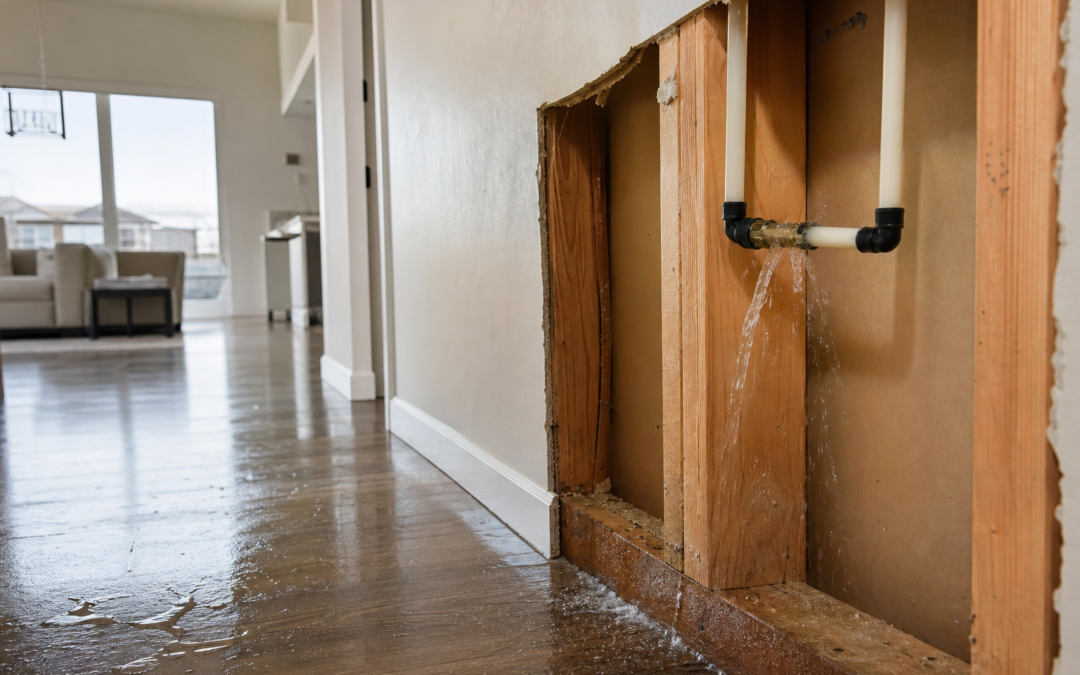
Most homes built here in the last decade use PEX tubing. It’s good material — flexible, freeze-tolerant, fast to install. That last quality is the problem. PEX connections are crimped or clamped by hand, hundreds of times per house, often by whoever was available during a build boom.
A fitting that’s slightly under-crimped won’t fail inspection and won’t leak on day one. It seeps. Two or three years later, that seep becomes a spray inside a wall cavity you have no reason to open. We’ve pulled drywall in three-year-old homes and found framing that had been wet for months.
2. Appliance supply lines finished in a hurry
The refrigerator water line, the washing machine hookups, the dishwasher supply — these get connected at the very end of a build, often during a rushed final walkthrough. A hand-tightened compression fitting holds fine under static pressure and then works itself loose over a couple of years of vibration.
An ice maker line behind a fridge is our single most common “how did this get so bad” call. The leak is hidden behind the appliance, it’s small, and it runs for weeks into the subfloor.
3. Grading that hasn’t finished settling
New lots move. Backfill around a foundation compacts for years after the certificate of occupancy, and the positive grade that was there at closing can flatten or reverse. Add a downspout that discharges too close to the house and you’ve built a funnel pointing at your foundation.
This is the failure that produces a wet basement with no plumbing problem at all — which is also the one homeowners argue with their insurer about, because it looks like a maintenance issue.
4. Crawl spaces and unconditioned corners
Homes finished quickly sometimes end up with under-insulated crawl spaces, garages with plumbing in an exterior wall, or bonus rooms above unheated space. Those are the pipes that freeze first in a Northern Colorado January, even in a brand-new house.
The Warranty Trap
Here’s what catches Windsor homeowners off guard. Your builder’s warranty typically covers the defect — the bad fitting, the failed connection. It usually does not cover the consequences: the hardwood that cupped, the drywall that has to come out, the cabinets that delaminated, the belongings in the basement.
Those consequences are what your homeowners insurance is for, and they’re the expensive part. Which means after a new-construction leak you’re often running two conversations at once — a warranty claim with the builder and an insurance claim on the damage.
Document accordingly. Photograph the failed component itself before anyone replaces it, because that part is the evidence in the warranty conversation, and plumbers throw it away by reflex.
What to Watch For in a Newer Windsor Home
- A water bill that crept up without a change in habits — the most reliable early sign of a hidden leak
- Warm or soft spots on a floor, or flooring that’s begun to cup or lift at a seam
- A faint musty smell that comes and goes, particularly in a basement or near an exterior wall
- Hairline cracks in drywall that reappear after being patched
- Efflorescence — chalky white residue on basement concrete, meaning moisture is moving through it
- Sounds of running water when every fixture in the house is off
Any one of these in a home under ten years old is worth an inspection. None of them are normal settling.
Simple Things That Prevent Most of This
- Replace braided steel supply lines on your washer and under sinks every five to seven years. They’re inexpensive and they’re the cheapest insurance in the house.
- Pull the fridge out once a year and look behind it. That’s it. Just look.
- Check your grade each spring. Soil should fall away from the foundation about six inches over the first ten feet. Add fill where it’s settled.
- Extend downspouts at least four feet from the foundation, further if the ground slopes back toward the house.
- Find your main shutoff and tag it so anyone in the house can find it in the dark.
- Consider leak sensors under the water heater, behind the fridge and at the washer. They’re inexpensive and they catch the slow leaks that do the most damage.
If You Find Water Right Now
Shut off the main. Kill power to any area with standing water if you can reach the panel safely. Photograph everything before you move or clean anything. Then call us at (720) 340-3499.
And call us before you call your insurance company. When we document the loss first — moisture readings, thermal imaging, a real scope of what’s wet — the claim gets filed with evidence behind it rather than a guess made in the first ten panicked minutes. We work directly with every carrier.
We’re Ten Minutes Away
Revive Restoration is based in Johnstown, about nine miles from Windsor, and we’re on-site in roughly 60 minutes, 24/7. Levi was born and raised in Northern Colorado and we’ve been family operated since 2016. We’ve worked in Water Valley, RainDance, Poudre Heights, Highpointe and the neighborhoods around Windsor Lake, and we know what these builds do.
Water damage in a newer Windsor home? Call (720) 340-3499 — day or night. The inspection is free, and if your home is dry we’ll tell you so.
See our full Windsor water damage restoration services, learn what to expect during the restoration process, or read about why Windsor basements flood. We also serve Severance, Timnath and Johnstown — see all our service areas.