Your basement is flooding, or water is coming through the ceiling, and your hands are shaking a little. Somewhere in the back of your mind you know insurance is going to ask questions later — but right now you just want the water to stop.
Here’s the thing almost nobody tells homeowners: the first 30 minutes are when your insurance claim is won or lost. What you photograph, what you save, and what you write down before anyone starts cleaning determines how smoothly this whole thing goes. It takes about ten minutes, and it can be worth thousands.
This is the checklist we wish every Northern Colorado homeowner had saved on their phone.
Step 1: Stop the Damage First (Safely)
Documentation matters, but not more than safety and not more than stopping the water. Before you start filming:
- Shut off the water at the source or the main if it’s an internal leak.
- Cut the power at the breaker to affected areas if water is near outlets or wiring — but never wade through standing water to reach a panel.
- Get everyone out of the affected area if there’s any question about ceiling collapse, sewage, or electrical hazard.
Your policy actually requires you to take reasonable steps to prevent further damage. Stopping the water isn’t just smart — it protects your claim.
Step 2: Photograph and Film Everything Before You Touch Anything
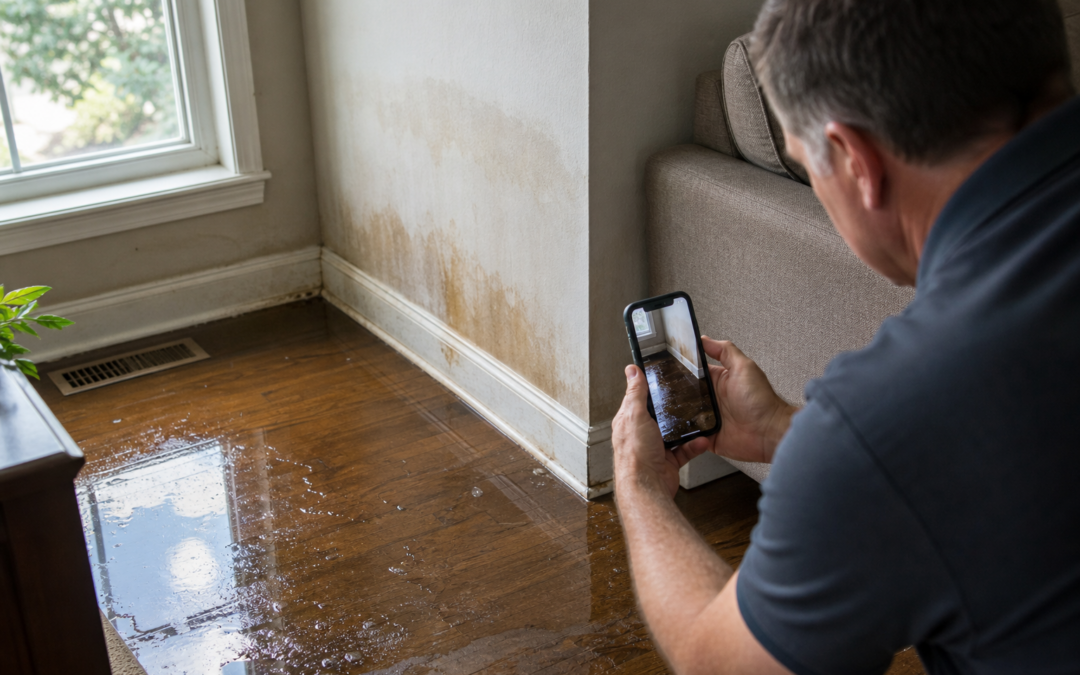
This is the single most valuable ten minutes you’ll spend. Adjusters can only evaluate what they can see, and by the time one visits, the water will be gone and the visible evidence with it.
- Shoot wide, then close. Start with a wide shot of each affected room from the doorway so the adjuster understands the layout and scale. Then move in for close-ups of specific damage.
- Take a slow walkthrough video narrating what happened and what you’re seeing. “This is the downstairs bathroom, the supply line under the sink failed around 6 a.m., water has spread into the hallway carpet.” That narration is powerful.
- Capture the water source itself — the burst pipe, the failed water heater, the appliance hose, the ceiling stain. This is what establishes the cause of loss.
- Get the water line. Photograph how high the water reached on walls, baseboards, and furniture legs. If it’s receding, mark the high point with tape or a pencil first.
- Document damaged contents individually — furniture, electronics, rugs, boxes of belongings. Personal property is usually a separate part of your claim from the structure.
- Include something for scale in close-ups when you can.
- Don’t delete anything. Too many photos is never the problem. Back them up to the cloud immediately.
Step 3: Don’t Throw Anything Away Yet
This is the mistake we see most often. A homeowner spends the day hauling soaked carpet, ruined furniture, and a failed water heater to the dump — and then the adjuster has nothing to inspect.
- Keep the failed part. The burst section of pipe, the cracked supply hose, the corroded water heater fitting. Bag it, label it, set it aside. It’s physical proof of a sudden, accidental failure — which is exactly the distinction that gets claims approved instead of denied as “gradual damage.”
- Don’t haul off damaged materials until they’ve been documented and you’ve been told it’s okay.
- Move undamaged items out of the area to prevent further loss — but photograph the room first.
- Keep every receipt from the moment this started: a hotel stay, a wet/dry vac rental, fans, tarps, a plumber’s emergency call. Many policies reimburse these.
Step 4: Start a Simple Damage Log
Open a note on your phone and keep a running record. It doesn’t need to be fancy — it needs to be contemporaneous, because notes written the same day carry far more weight than a memory reconstructed six weeks later.
Record:
- What happened and when — the date and approximate time you discovered the damage
- Where — every room and area affected, including ones where damage showed up later
- What you did — shut off the main at 6:15, called a plumber at 6:20, etc.
- Every conversation — who you spoke with, at what company, on what date, and what they told you. Get names.
- A running list of damaged items with rough age and purchase price if you know it
Step 5: Call a Restoration Company Before You Call Your Insurer
This surprises people, so let us explain the reasoning.
When you call Revive first, we arrive with tools your phone camera doesn’t have — moisture meters, thermal imaging cameras, and hygrometers. We can show, with documented readings, exactly how far the water traveled inside your walls, under your flooring, and into your subfloor. That’s damage that’s completely invisible in photos but very real on your repair bill.
That professional moisture mapping becomes part of your claim file. Instead of an adjuster estimating from what’s visible, they’re working from measured data. In our experience, that’s the difference between a claim that covers the actual scope of work and one that covers only what showed on the surface.
We also start drying immediately, which limits secondary damage — and preventing further damage is something your policy expects of you anyway. We work with all insurance carriers, and we’re glad to coordinate directly with your adjuster.
What Not to Do
- Don’t guess at your coverage or assume you’re not covered. Report the loss and let the process determine it.
- Don’t sign anything you don’t understand, including a release, until you know the full scope of damage.
- Don’t accept the first number if it doesn’t account for what’s inside the walls. Hidden moisture is the most commonly underestimated part of a water claim.
- Don’t wait. Most policies require prompt notice, and mold can start within 24–48 hours — and mold caused by delayed response is a very common reason for a partial denial.
We’ll Help You Get This Right
Revive Restoration is locally owned and family-operated, born and raised right here in Northern Colorado. We’re available 24/7 with a 60-minute response time, we work with every insurance carrier, and we’ve walked hundreds of local homeowners through exactly this process.
Even if you’re not sure how bad the damage is — call us. We have the tools to find what you can’t see, and the inspection is free.
Water damage right now? Call Revive Restoration at (720) 340-3499 before you call your insurance company.
Serving All of Northern Colorado
We respond 24/7 across the Front Range, including Fort Collins, Loveland, Greeley, Windsor, Longmont, and Broomfield. See every community we cover on our service areas page, or learn more about our water damage restoration services.