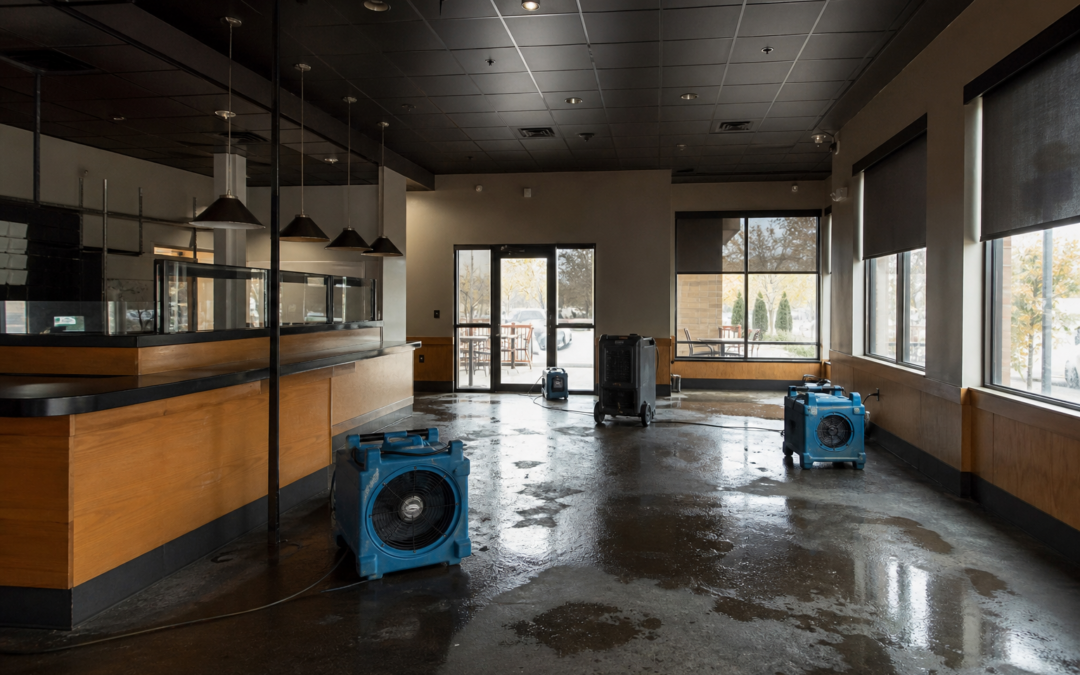
When a pipe fails in a home, the family is inconvenienced. When a pipe fails in a restaurant, a dental office, or a retail storefront, the meter starts running immediately — on lost revenue, on payroll for staff who can’t work, on rent that’s due whether the doors are open or not.
For most commercial property owners, the repair bill isn’t the expensive part of a water loss. Being closed is. Here’s how business interruption coverage actually works, and what determines how long you’re shut down.
What Business Interruption Coverage Is
Business interruption (BI) coverage — sometimes called business income coverage — is a separate part of a commercial policy from your property coverage. Property coverage pays to fix the building and replace damaged equipment. BI coverage replaces the income you lose while you can’t operate.
A typical BI policy covers:
- Lost net income you would have earned during the shutdown period
- Continuing operating expenses that don’t stop just because you’re closed — rent, loan payments, utilities
- Payroll, so you can keep trained staff rather than losing them to another employer
- Extra expense — the cost of temporarily operating somewhere else, renting equipment, or paying overtime to reopen faster
Critically, BI coverage is almost always triggered by a covered physical loss to your property. A burst pipe or a sudden appliance failure typically qualifies. Flooding from surface water generally does not, unless you carry separate flood coverage — a gap that catches a lot of Front Range businesses off guard after heavy runoff.
The Two Details That Surprise Owners Most
The waiting period. Most BI policies have a deductible expressed in time rather than dollars — commonly 48 or 72 hours. Losses in that initial window aren’t covered. This means a short closure may produce no BI payout at all, while a two-week closure produces a substantial one.
The period of restoration. Coverage runs for the time it should reasonably take to repair the damage — not necessarily the time it actually takes. If your restoration drags because of slow response, delayed decisions, or a contractor who can’t staff the job, those extra weeks may fall outside the covered period.
Both of these point in the same direction: the speed and competence of your restoration response has a direct financial consequence.
Why Fast Response Is Financial, Not Just Operational
Every hour water sits in a commercial space, the scope of work grows:
- Water wicks up drywall and into insulation, turning a dry-out into a demolition
- Commercial flooring — glue-down vinyl, sealed concrete, carpet tile — delaminates and fails
- Inventory, records, and equipment get damaged past salvage
- Mold can begin developing within 24 to 48 hours, which adds a remediation phase and can trigger health department involvement for food service and medical facilities
A bigger scope means a longer closure. A longer closure means more lost revenue, more risk of exceeding your period of restoration, and more customers who found somewhere else to go. Getting professional extraction and drying started within hours rather than the next business day is often the difference between reopening in days and reopening in weeks.
Documentation for a BI Claim Is Different
A property claim is about the building. A BI claim is about your books — and it requires evidence most owners don’t have organized in an emergency. Start gathering:
- Profit and loss statements for the prior two to three years, plus year-to-date
- Monthly revenue history, so seasonality is accounted for — important for anyone whose business swings with the CSU calendar, tourist season, or the holidays
- Tax returns and payroll records
- Documentation of continuing expenses — lease, loans, utilities, subscriptions
- A daily log of the closure — when you closed, what was inaccessible, when each area came back online
- Every extra expense receipt, including temporary space, equipment rental, and overtime
- Records of cancelled orders, bookings, or appointments
- Photos and video of the damage before anything is moved, plus documented moisture readings
Keep a copy of your critical financials somewhere off-site or in the cloud. Owners who lost their records in the same event they’re filing about have a much harder time.
How We Help Commercial Clients Reopen Faster
Our approach on commercial jobs is built around limiting downtime:
- 24/7 emergency response with a 60-minute response time — because the clock starts the moment the water does
- Documented moisture mapping with thermal imaging and meters, establishing the true scope for your carrier from day one
- Phased drying where possible, so unaffected areas of your operation can reopen while work continues elsewhere
- Daily monitoring and documented drying logs that support both your property and BI claims
- Direct coordination with your adjuster — we work with all insurance carriers
Our strongest recommendation for any commercial owner: have a restoration company’s number in your phone before an emergency. The businesses that reopen fastest are the ones that didn’t spend the first four hours searching for someone to call.
Call Us First
Revive Restoration is locally owned and family-operated by Levi, born and raised in Northern Colorado. We serve commercial properties across the Front Range — retail, restaurants, offices, medical and dental practices, warehouses, and multi-family buildings.
Call us before you call your insurance company. We can be on site quickly, start limiting the damage, and document everything properly from the beginning — which makes both your property claim and your business income claim substantially stronger.
And if you’re not sure how bad it is, call anyway. We have the tools to find moisture inside walls, ceilings, and flooring that you’d otherwise discover weeks later. The inspection is free.
Commercial water damage? Call Revive Restoration 24/7 at (720) 340-3499.
Serving Businesses Across Northern Colorado
We respond to commercial water damage throughout the Front Range, including Fort Collins, Loveland, Greeley, Windsor, Longmont, and Broomfield. See every community we cover on our service areas page, or learn more about our water damage restoration services.