

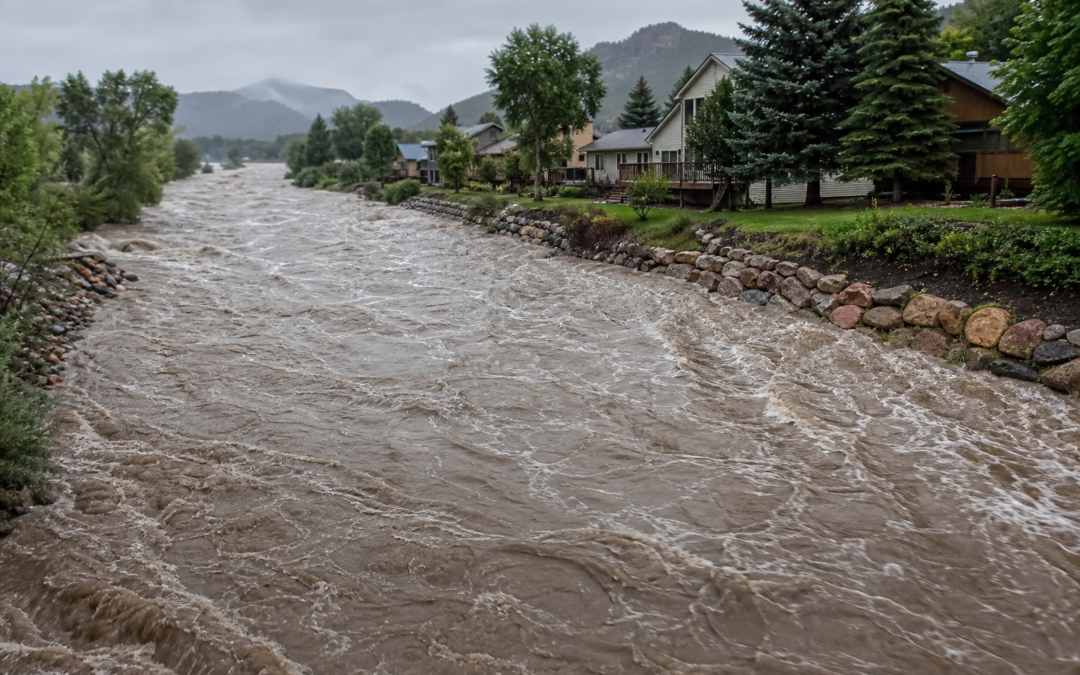
Loveland has a relationship with the Big Thompson that most cities don’t have with their river.
In 1976, a wall of water came down the canyon in one of the deadliest floods in Colorado history. In September 2013 it happened again — less catastrophic, still enormous. Inside Loveland city limits, 66 buildings were impacted. More than 1,000 were affected in adjacent county areas. Emergency crews performed 80 rescues in under an hour. US 34 through the canyon was destroyed and took until 2018 to fully rebuild.
Most Loveland homes are nowhere near the canyon, and this post isn’t about scaring anyone. It’s about the fact that the same water behavior that makes the Big Thompson dangerous in an extreme year shows up in ordinary Loveland neighborhoods every single spring — quietly, in basements, in ways that most homeowners misread.
Water Arrives Here in Three Different Ways
Understanding which one you have determines what you do about it and who pays for it.
1. River and canyon flooding
The dramatic version, and the rarest. Driven by extreme rainfall over the burn scars and steep terrain west of town, which sheds water instead of absorbing it. If you’re along the river corridor or near the canyon mouth, this is a real exposure — and it is not covered by homeowners insurance. It needs a separate flood policy.
2. Snowmelt and a rising water table
The common one, and the one people misdiagnose. A warm stretch in March or April melts the snowpack faster than the ground can take it. Soil that’s still frozen or already saturated can’t absorb the water, so the water table lifts. Hydrostatic pressure builds against your foundation — and water is patient. It finds the cold joint where the wall meets the floor, hairline cracks, the gap around a pipe penetration, and the window wells.
No pipe broke. Nothing “failed.” Your basement is simply below the water table for a few weeks a year. Homeowners insurance generally does not cover this either.
3. Cloudbursts and surface water
A summer thunderstorm parks over your neighborhood and drops more rain in twenty minutes than the storm system can move. Water sheets across the ground, finds the low spot — often a window well or a below-grade entry — and comes in. This is about your property’s grade and drainage far more than about the river.
How to Tell Groundwater from a Plumbing Leak
Two inches of water on a basement floor looks the same either way, but the cause changes everything about the claim. Some practical signals:
Likely groundwater or surface water if:
- It appears at the floor-to-wall joint, along the base of walls, or in window wells
- It’s seasonal — spring melt, or after heavy rain, and dry the rest of the year
- Several neighbors have it at the same time
- There’s white powdery efflorescence on the concrete, a mineral residue left by water passing through the wall
- The water is cold and clear, and there’s no plumbing on that wall
Likely a plumbing failure if:
- It appeared suddenly with no weather event
- It’s near a fixture, appliance, water heater or supply line
- It’s warm, or it’s still actively running
- Your water meter moves with every fixture in the house shut off
- Your water bill jumped
The distinction matters enormously: sudden plumbing failure is usually covered. Groundwater seepage usually isn’t. We determine which one you have with moisture mapping before anyone files anything, because filing the wrong thing is hard to walk back.
What Actually Keeps a Loveland Basement Dry
In rough order of cost-effectiveness:
- Fix the grade. Soil should fall away from the foundation about six inches over the first ten feet. Settled soil, added patios and mature landscaping frequently reverse this over the years. Cheapest fix, biggest effect.
- Extend the downspouts. Four to six feet minimum, farther if you can. A downspout dumping at the foundation delivers thousands of gallons exactly where you don’t want it.
- Cover your window wells and make sure each one has a functioning gravel drain. Window wells are the single most common entry point we see in Loveland.
- Clean the gutters — spring and fall. Overflowing gutters concentrate roof runoff against the foundation.
- Test the sump pump before you need it. Pour a bucket of water into the pit and confirm it kicks on and discharges. Do this in February, not April.
- Add a battery backup sump pump. Storms cause power outages, and the moment you most need the pump is the moment the power is most likely out. This is the upgrade Loveland homeowners skip and regret.
- Seal obvious foundation cracks — worthwhile, though understand it treats a symptom. If hydrostatic pressure is the real problem, water will find the next path.
- Interior perimeter drain to a sump. The real fix for chronic groundwater, and priced accordingly. If your basement takes water every spring, this is the conversation to have.
If You’re Along the River, Two More Things
Know your flood policy status. Homeowners insurance excludes flood. NFIP flood policies typically carry a 30-day waiting period, so it cannot be bought when a forecast turns bad. That decision has to be made on a calm day.
Sign up for Larimer County emergency alerts. Loveland’s early flood warning system did its job in 2013 — a call to the city’s floodplain engineer was the first indication of what was coming. Warning time only helps the people who receive it.
When Water Does Get In
Safety first: if water is near outlets or the panel, stay out and cut power from a dry location if you can do so safely. Treat outdoor floodwater as contaminated — it has crossed streets, lawns and possibly storm drains, so porous materials that absorbed it usually need to come out rather than be dried.
Photograph everything before you move anything. Get belongings up off the floor. Then call us before you call your insurer — on a groundwater-versus-plumbing question, the cause determination drives the whole claim, and it is far better to have moisture readings and a documented scope before that conversation than to argue afterward.
And don’t assume a dry-looking floor means it’s over. Concrete and framing hold water long after the surface looks fine, and mold can start in trapped moisture within 24 to 48 hours.
Call Even If You’re Not Sure
Damp smell every spring? A dark line along the bottom of a basement wall? White chalky residue on the concrete? Those are all worth a look, and the inspection is free. We would much rather tell you your basement is fine than meet you next spring with mold behind the drywall.
Basement water or flooding in Loveland? Call Revive Restoration at (720) 340-3499 — 24/7. Family operated since 2016, owned by Levi, born and raised in Northern Colorado.
See our full Loveland water damage restoration services, or read our other Loveland guides: hail damage that becomes a roof leak, finished basement water damage, and what happens after you call. We also serve Berthoud, Johnstown, Windsor and Fort Collins — full list on our service areas page.