

On the night of July 28, 1997, up to 14.5 inches of rain fell on Fort Collins in 31 hours. Spring Creek left its channel. Five people died, roughly 200 homes were destroyed and about 1,500 homes and businesses were damaged. A railroad embankment overtopped and derailed a train. CSU took over $100 million in damage on its own, including the Morgan Library.
It remains the worst natural disaster in the city’s history, and it produced something genuinely valuable: a stormwater overhaul serious enough that when the 2013 floods devastated much of Northern Colorado, Fort Collins largely escaped.
That’s a real success story. It’s also why we meet so many Fort Collins homeowners who believe flooding here is a solved problem.
The infrastructure got much better. Your house did not.
What Improved, and What It Can’t Fix
Fort Collins invested heavily in detention, channel improvements, mapping and one of the country’s more sophisticated rainfall monitoring approaches — the 1997 flood directly contributed to the development of a national precipitation reporting network. Vulnerable basement-level areas on the CSU campus were physically walled off from future flooding.
All of that reduces citywide risk enormously. None of it does anything about:
- Rain falling faster than any system can move it, which is what a stationary summer thunderstorm over the foothills does
- Your specific lot’s grade and drainage
- Window wells without covers or functioning drains
- Below-grade entries, walk-out doors and garage aprons that sit lower than the surrounding ground
- Sump pumps that fail during the power outage the storm caused
- Storm drains blocked by leaves and debris at the moment they’re needed most
Municipal infrastructure protects neighborhoods. The last thirty feet — from the street to your foundation — is yours.
The Fort Collins Flash Flood Pattern
Our summer storms have a particular character. Moisture pools against the Front Range, storms build over the foothills in the afternoon, and one can park over a few square miles and unload. Rainfall totals vary wildly across short distances — it’s entirely normal for one Fort Collins neighborhood to get two inches while another gets nothing.
That variability is why “it’s not raining at my office” is not information about your house.
Two aggravating factors:
Burn scars. Land burned by wildfire west of town sheds water rather than absorbing it, for years afterward. Rain that would have soaked in becomes runoff, and it arrives faster and carries debris.
Hard ground. Colorado soil bakes dry and develops a crust that initially repels water. The first heavy rain after a dry spell runs off far more than people expect.
Where the Water Actually Enters
Over hundreds of calls, the entry points repeat:
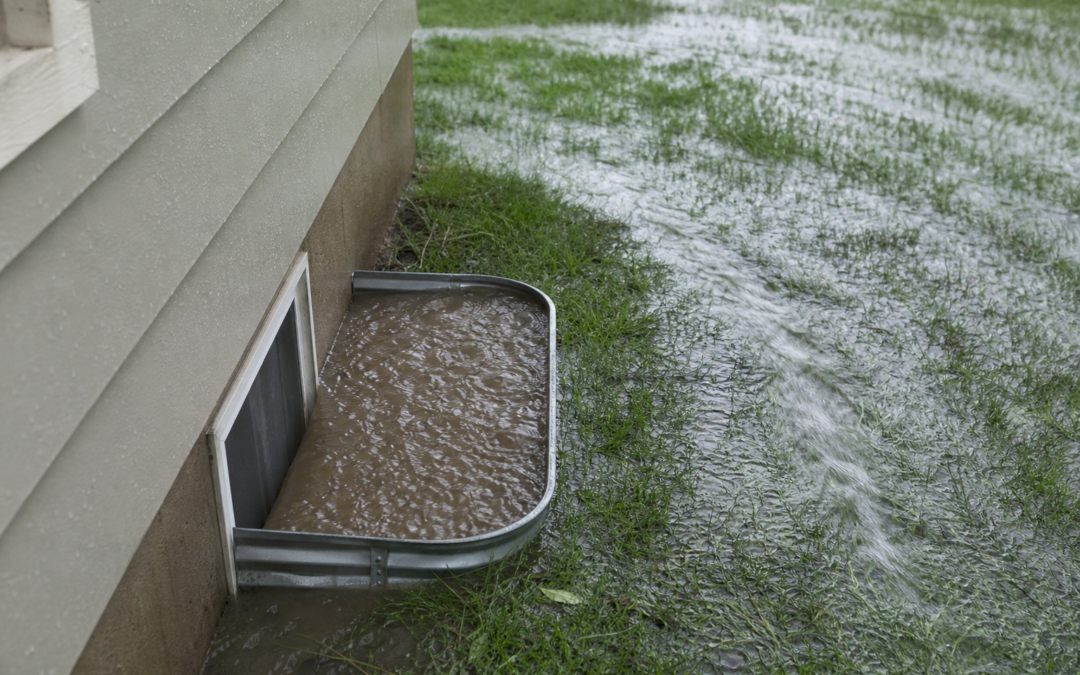
- Window wells. The number one culprit. An uncovered well is a bucket set beside your foundation with a window at the bottom. Once it fills past the sill, water comes through the frame — and window glass can break inward under the pressure.
- Below-grade doors and stairwells. Walk-out basements and exterior basement stairs collect water and hold it against a door that was never designed to be a dam.
- The floor-to-wall joint. When ground around the foundation saturates, hydrostatic pressure pushes water through the cold joint where the slab meets the wall.
- Foundation cracks and pipe penetrations. Any opening where a line passes through the wall.
- Backward through floor drains when the storm system surcharges.
- Garages, where the apron slopes in and there’s no threshold to stop sheet flow.
What to Do Before the Next Storm
- Cover your window wells. Clear polycarbonate covers are inexpensive and prevent the most common failure we see. Also confirm each well has a working gravel drain rather than a plugged one.
- Walk your lot in the rain. Genuinely — put on a jacket and watch where water goes during a real downpour. You’ll learn more in ten minutes than from any map.
- Fix the grade. Six inches of fall over the first ten feet from the foundation. Settled soil and added landscaping frequently reverse this.
- Extend downspouts four to six feet out, farther if the lot allows.
- Clear the gutters and the storm drain nearest your house. Clearing leaves off a curb inlet before a storm helps your whole block.
- Test the sump pump with a bucket of water, and add a battery backup. Storms cause outages, and an unpowered pump during a flash flood is exactly the wrong moment for it.
- Get belongings off the basement floor. Twelve inches of shelving.
- Enable emergency alerts on your phone and sign up for Larimer County notifications. Flash floods move faster than the news cycle.
- Know your coverage. Homeowners policies exclude flood. If you want flood coverage you buy it separately, and NFIP policies carry a 30-day waiting period — it cannot be purchased when a storm is in the forecast. Also check whether you carry a sewer backup endorsement, because a surcharged storm system can push water back into your basement.
During and After
Never drive into water across a road. Most flood deaths are vehicles. You cannot tell how deep it is or whether the road is still under it. This was true in 1997 and it’s true now.
If water is entering your home, get everyone to the highest floor. Do not enter a flooded basement if water is near outlets or the panel — electricity and standing water is how people die during cleanup rather than during the flood.
Once it’s safe: photograph everything before anything moves. Treat outdoor floodwater as contaminated — it has crossed streets, yards and storm drains, which means porous materials that soaked it generally need to be removed rather than dried.
Then call us before you call your insurance company. On storm water the cause determination drives the entire claim, and there’s a meaningful difference between surface flooding, a sewer surcharge and a plumbing failure that happened to coincide with a storm. We document which one you actually had, with moisture readings and thermal imaging, and provide it in the format adjusters expect.
Call Even If You’re Not Sure
After a big storm we get a lot of “it came in but we got it cleaned up, I think we’re fine” calls. Those are worth making. Concrete and framing hold water long after a floor looks dry, and mold can begin in trapped moisture within 24 to 48 hours. Our inspection is free and takes very little of your day.
Fort Collins learned in 1997 that water shows up faster than anyone expects. The lesson still holds at the individual house level.
Storm or flood damage in Fort Collins? Call Revive Restoration at (720) 340-3499 — 24/7. Family operated since 2016, owned by Levi, born and raised in Northern Colorado.
See our full Fort Collins water damage restoration services, or read our other Fort Collins guides: water damage in Old Town’s older homes, water damage for rental property owners, spring snowmelt basement flooding, and the first 24 hours after water damage. We also serve Timnath, Wellington, Windsor and Loveland — full list on our service areas page.