

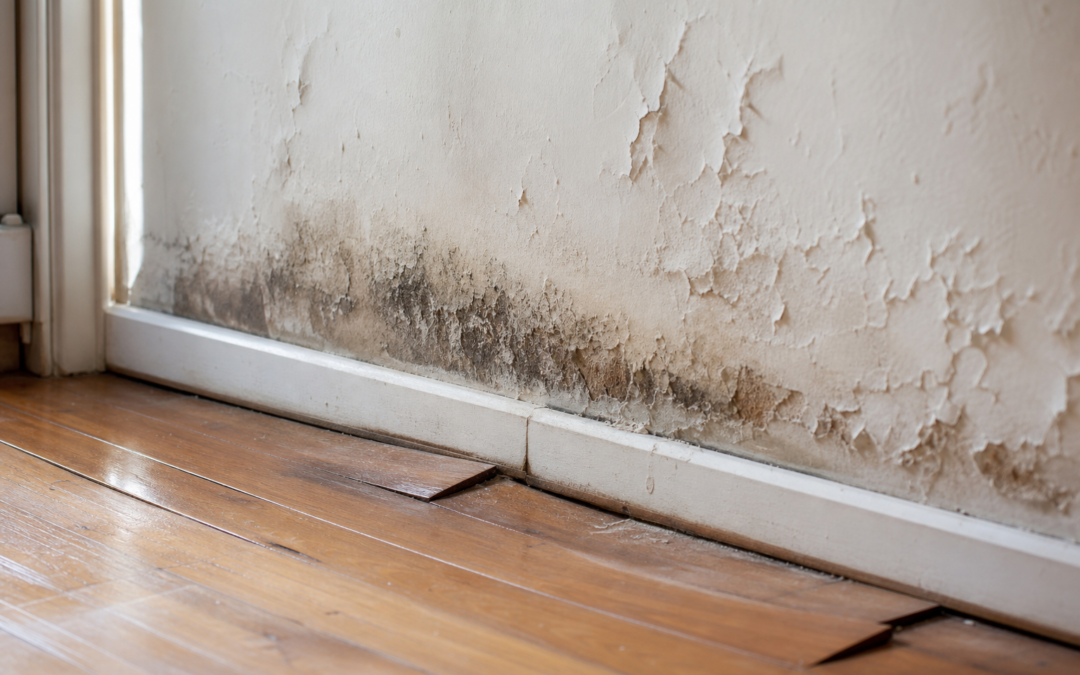
Not every water problem announces itself. Some of the most expensive damage we see in Northern Colorado homes started as a leak nobody could find — a water bill that crept up, a smell in a closet, a spot on the floor that felt a little soft. No flood, no drama. Just weeks of moisture doing quiet work inside a wall.
If you suspect something and cannot find it, that is exactly when to call. Revive Restoration will come out and find it — (720) 340-3499, free inspection, no obligation.
The warning signs of a hidden leak
Your water bill jumped and nothing else changed. This is the most reliable early signal there is. A pinhole leak can waste hundreds of gallons a day without ever appearing on a surface.
A musty, earthy, or “old basement” smell. Especially in a closet, a cabinet, a corner of a room, or near a bathroom. Your nose usually finds mold before your eyes do.
Warped, cupped, or lifting flooring. Hardwood cupping in the middle of a room, laminate edges swelling, vinyl bubbling, or tile grout that has started to darken and crumble.
Bubbling paint or soft drywall. Paint that peels or blisters on an interior wall, drywall tape lifting at a seam, or a wall that gives slightly when you press on it.
Stains that come back. You painted over a spot and it reappeared. That is not a paint problem.
Carpet that is damp with no explanation. Particularly along a baseboard or against an exterior wall.
A section of floor that is unusually warm. Warm spots on a slab often mean a hot water line leaking underneath.
The meter test. Turn off every fixture and appliance in the house, then watch your water meter for fifteen minutes. If it moves at all, water is going somewhere.
Sound. A faint hiss or trickle when the house is quiet and nothing is running.
Unexplained increase in humidity. Windows fogging, or a room that just feels clammy compared to the rest of the house.
Where hidden leaks usually come from
- Slab leaks. Supply lines running under a concrete slab. Common in Front Range homes, and almost impossible to spot without equipment.
- Pipes inside walls. Pinhole corrosion, failed solder joints, or a nail from a long-ago picture hanging that has slowly worn through.
- Under-sink supply lines and angle stops. Braided lines have a service life. Check under every sink twice a year.
- Shower pan and tile failures. One of the top hidden leaks we find. A cracked pan or failed grout sends water into the subfloor with every shower, and nothing looks wrong from inside the bathroom.
- Toilet flange and wax ring failures. Slow seepage under the toilet base rots the subfloor from below. The tell is a toilet that rocks slightly.
- Refrigerator and ice maker lines. Behind the fridge, out of sight, dripping into the flooring for months.
- Water heater and HVAC condensate lines. Slow drips that stain a wall or feed a crawl space.
- Crawl space plumbing. If you have a crawl space and have not looked in it this year, look. Our crawl space guide explains what to look for.
Why hidden leaks are a mold problem waiting to happen
Mold needs moisture, an organic food source, and time. A hidden leak provides all three perfectly: continuously damp drywall paper and wood framing, no airflow, no light, and weeks or months of undisturbed growth. Mold can begin within 24 to 48 hours of materials getting wet — a leak that has run for a month is not an early-stage problem.
That is the real cost of a hidden leak. The plumbing repair is often minor. The remediation and rebuild of everything the water quietly ruined is not.
How Revive finds a leak you cannot see
We do not open walls hoping to get lucky. We use thermal imaging to spot temperature differences caused by moisture inside assemblies, pin and pinless moisture meters to measure actual moisture content in wood, drywall, and subfloor, and hygrometers to compare humidity room to room. We trace the moisture pattern back to its source and then confirm it before anything gets cut.
You get a clear answer: where the water is coming from, how far it has spread, what materials are affected, and what it will take to fix. If it turns out to be minor, we will say so — that is what a free inspection is for.
Call Revive before you call insurance
Slow-leak claims get scrutinized more than sudden ones, because carriers look closely at how long the leak was running. Having professional moisture documentation from the first day protects you. Call us first, let us map it and write the scope, and then call your insurer with evidence in hand. We deal with adjusters constantly and will talk to yours directly.
Do not wait for it to declare itself
Every week a hidden leak runs is more subfloor, more framing, more drywall, and more chance of mold. If your gut says something is wrong in your house, it is usually right.
Suspect a leak but cannot find it? Call Revive Restoration at (720) 340-3499 — free inspection anywhere in Northern Colorado. We will find it before it gets worse.