
Most people start thinking about basement waterproofing right after a scare. Either their basement took on water, or a neighbor’s did, and suddenly the question is: should I be doing something before this happens to me?
It is a fair question, and it deserves an honest answer rather than a sales pitch. We are a restoration company, not a waterproofing contractor — we get paid when basements flood, not when they stay dry. So here is our straight take.
If you want a professional set of eyes on your basement before the next storm, call Revive Restoration at (720) 340-3499. The inspection is free, and if you do not need anything, we will tell you that.
What “waterproofing” actually means
The word covers several very different jobs, and understanding which one you are being sold matters.
Interior drainage systems. A perimeter drain channel cut into the basement floor slab, routed to a sump pit and pump. This does not stop water from reaching your foundation — it manages water that gets in and gives it somewhere to go. It is the most common retrofit and often the most effective for chronic seepage.
Sump pump systems. A pit, a pump, and ideally a battery backup. If you already have one, the backup is usually the highest-value upgrade you can make, because the worst storms are also the ones that knock the power out. See our sump pump failure guide.
Exterior excavation and sealing. Digging down to the footing, applying a membrane, and installing exterior drain tile. The most thorough and by far the most expensive and disruptive.
Grading, downspouts, and window wells. The unglamorous one. Extending downspouts, correcting negative grade, adding window well covers. Frequently the cheapest fix and frequently the one that actually solves the problem.
Crack injection. Epoxy or polyurethane injection for specific foundation cracks that are actively leaking.
What none of it fixes: plumbing failures, appliance leaks, water heater ruptures, sewer backups, or a frozen pipe in an exterior wall. Waterproofing is for groundwater and surface water only. Most of the flooded basements we respond to in Northern Colorado were caused by something inside the house.
Signs your basement is at risk even if it has never flooded
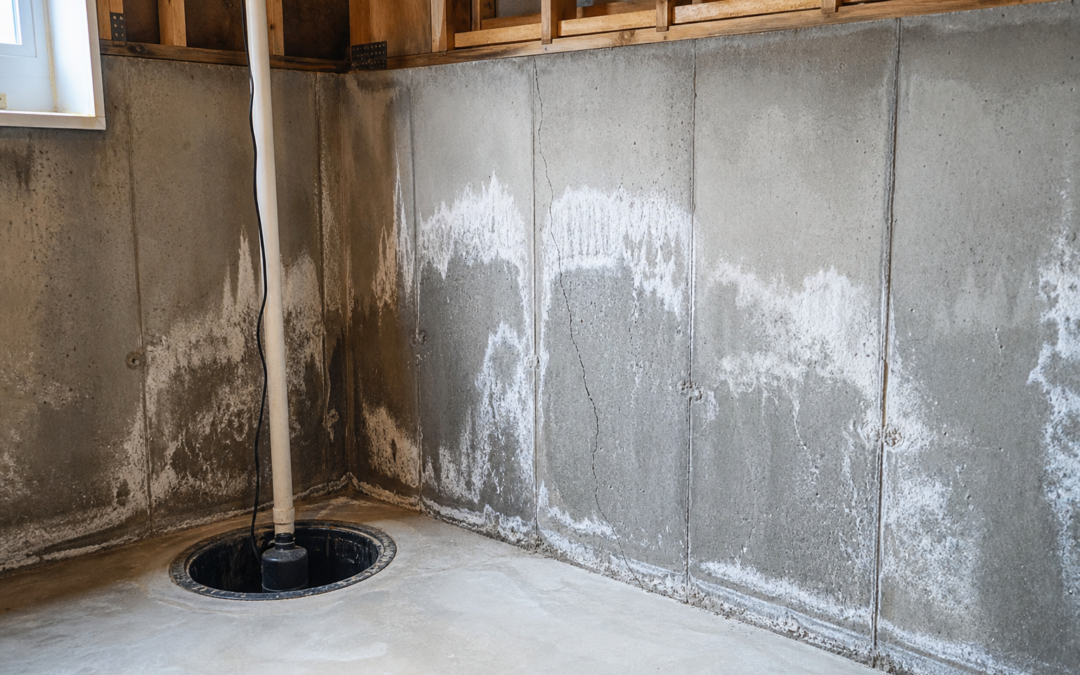
- Efflorescence — white, chalky mineral deposits on foundation walls. Proof that water has moved through the concrete.
- A musty smell that is stronger after rain or snowmelt.
- Hairline cracks in the foundation wall or floor, especially ones that darken when wet.
- Damp spots or staining at the base of walls, or paint peeling near the floor.
- Water in the window wells after a storm, or wells filled with debris and no cover.
- Downspouts that discharge within a few feet of the foundation, or grade that slopes toward the house.
- High humidity — consistently above roughly 60 percent down there.
- A sump pit that runs frequently, or one that has never been tested.
When waterproofing makes sense, and when it is overkill
It usually makes sense if: your basement has taken on groundwater more than once, you see efflorescence or active seepage through walls or the floor-wall joint, your lot sits low or has a high water table, you are finishing the basement and about to put drywall and flooring over a known risk, or you are already dealing with chronic humidity and mold.
It is often overkill if: your only water event came from a burst pipe or a failed appliance, your basement is dry and you have never seen efflorescence or seepage, or you have not yet done the cheap things. That last one matters. We have seen plenty of homeowners quoted five figures for interior drainage when the actual cause was two downspouts dumping against the foundation and a flowerbed graded backward. Fix drainage, grading, window wells, and gutters first, then re-evaluate after a wet season.
A reasonable middle path for most Northern Colorado homes: correct exterior drainage and grading, cover the window wells, and add a battery backup to the sump pump. That combination handles a large share of the risk for a fraction of the cost of excavation.
Why we can help even though we do not sell waterproofing
Because we are the ones who see what failed. We can inspect your basement, measure actual moisture content in the walls and floor, use thermal imaging to find where water has been moving, check your sump setup, and tell you where your real vulnerability is. Then we tell you which category of fix is warranted — and refer you to waterproofing and foundation contractors we trust when one is.
No commission, no upsell. Just an assessment from a company that responds to flooded basements across Northern Colorado every week.
And if it floods anyway
Call us before you call insurance. Get it documented, mapped, and scoped by a restoration professional first — groundwater and seepage claims in particular get examined closely, and the difference between a paid claim and a denied one is usually the quality of the evidence gathered on day one.
Not sure if your basement is at risk? Free inspection — call Revive Restoration at (720) 340-3499. 24/7 across Northern Colorado.