

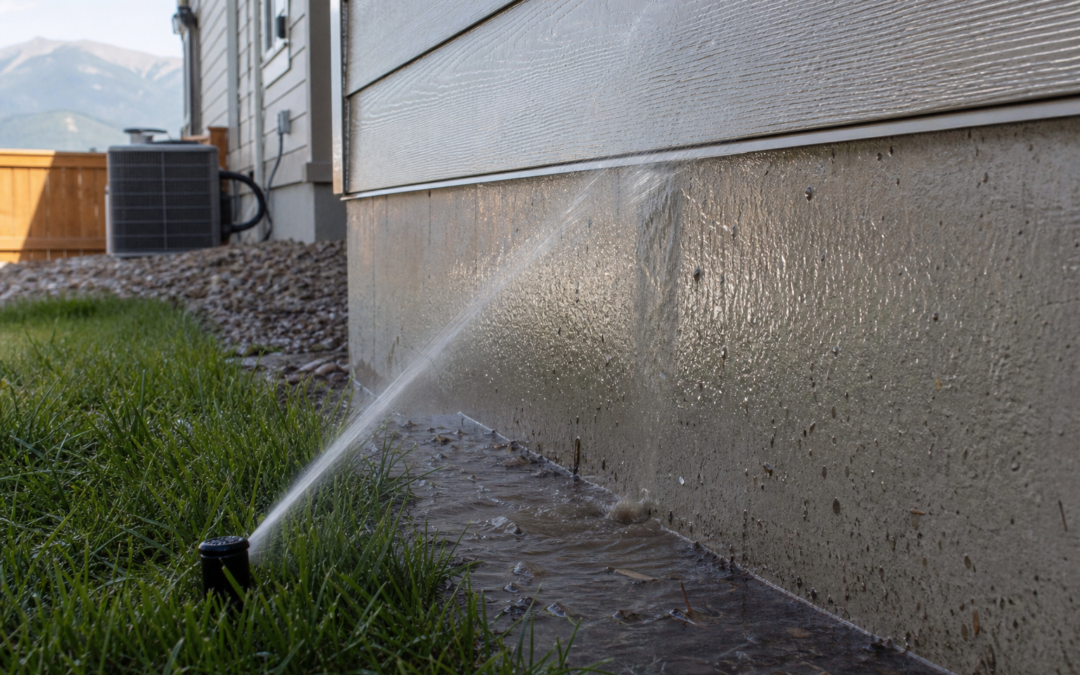
Every August we get the same call from somewhere in Northern Colorado: a homeowner has a damp basement wall, a musty smell in the corner of a finished room, or a wet patch on the carpet — and there hasn’t been rain in two weeks.
They’re baffled. We’re not. Nine times out of ten, the water isn’t coming from the sky. It’s coming from the sprinklers.
How irrigation leaks turn into basement water damage
Late summer is peak irrigation season along the Front Range. Systems run daily, often before sunrise, often for 20–30 minutes per zone. That’s a lot of water going into the ground right next to your foundation, every single day, for months. Here’s how it gets inside:
- A cracked lateral line or broken fitting dumps water in one spot instead of distributing it. Underground, you never see the puddle — but the soil next to your footing stays saturated.
- Heads spraying the house soak siding, window wells, and the foundation wall directly. A misaligned head can put gallons a day against one point of your home.
- Grading that slopes toward the house turns normal watering into a funnel. Colorado’s expansive clay soils shift and settle over the years, so grading that was correct at build can be wrong a decade later.
- Saturated clay soil expands and puts lateral pressure on foundation walls. Over time that opens hairline cracks — and hydrostatic pressure pushes water right through them.
- Over-watering near window wells and egress windows fills them faster than they drain, and water finds the window seal.
The insidious part: this damage is slow. There’s no dramatic flood, no obvious event to point at. Just weeks of moisture quietly feeding the drywall, framing, and insulation behind your finished basement wall.
The warning signs — and the one clue that gives it away
Watch for:
- Damp or discolored basement walls, especially low on the wall near the floor
- A persistent musty or earthy smell that comes and goes
- White chalky residue (efflorescence) on concrete foundation walls
- Peeling or bubbling paint on basement drywall
- Soft, spongy, or cupping baseboards and flooring
- Wet spots in the crawl space, or insulation that has slumped and fallen
- Warped drywall corners or nail pops
And the clue that confirms it: the moisture follows your watering schedule. If the wall is damp Tuesday and Thursday mornings and drier by the weekend, and your zones run Monday and Wednesday nights — you’ve found your source. Turn the system off for a week and see if the pattern stops.
Why slow moisture is worse than a fast flood
A burst pipe is loud, obvious, and gets addressed in an hour. An irrigation leak gets addressed in October.
That difference matters, because mold begins growing on damp organic material in as little as 24 to 48 hours. Weeks of low-level moisture behind a finished wall is close to ideal conditions: dark, humid, no airflow, and plenty of paper-faced drywall and wood framing to feed on. By the time you smell it, there’s usually colonization inside the wall cavity, not just on the surface.
Chronic saturation also degrades the structure itself — wood rot in sill plates and joists, rusting fasteners, deteriorating concrete — and that repair is dramatically more expensive than drying a wall would have been in August.
What to check in your yard this week
- Walk each zone while it’s running. Look for geysers, soggy ground, heads spraying the house, and heads that mist instead of spray (a sign of pressure loss from a leak elsewhere).
- Check your water bill. An unexplained jump often means an underground leak.
- Aim heads away from the foundation. Nothing should be watering your siding.
- Verify the grading. Soil should drop about 6 inches over the first 10 feet away from the house. Fill low spots against the foundation.
- Keep drip zones off the foundation. Move emitters at foundation plantings 12–18 inches out.
- Clear window wells and confirm their drains actually drain. If yours fill regularly, basement waterproofing may be worth it.
- Cut back watering time rather than watering more per cycle — shorter, more frequent cycles reduce runoff and deep saturation.
Who to call: your irrigation company or a restoration company?
Both, in this order — and the order depends on what you’re seeing.
Call your irrigation contractor to find and repair the leak itself. That’s their specialty, and the source has to be fixed or nothing else holds.
Call Revive Restoration if any water has made it inside — damp drywall, wet carpet, musty smell, visible mold, or a wet crawl space. That’s no longer a sprinkler problem, it’s a water damage problem, and it needs moisture mapping, structural drying, and antimicrobial treatment to resolve properly. A yard repair does nothing for moisture already inside your wall cavity.
And if there’s any question of an insurance claim: call Revive before you call your insurance company. Gradual-damage exclusions make irrigation-related claims tricky, and how the loss is documented and described from the start makes an enormous difference. We’ll inspect, document the full scope with meter readings and photos, and tell you honestly where you stand before anything gets reported.
Don’t let this one ride until fall
Every year we dry out basements in October that could have been a two-day job in August. If your basement smells musty or a wall feels cool and damp to the touch, get it looked at now — while it’s still small.
Revive Restoration offers free inspections across Northern Colorado — Johnstown, Loveland, Windsor, Greeley, Fort Collins, and the Front Range. Call 24/7: (720) 340-3499.