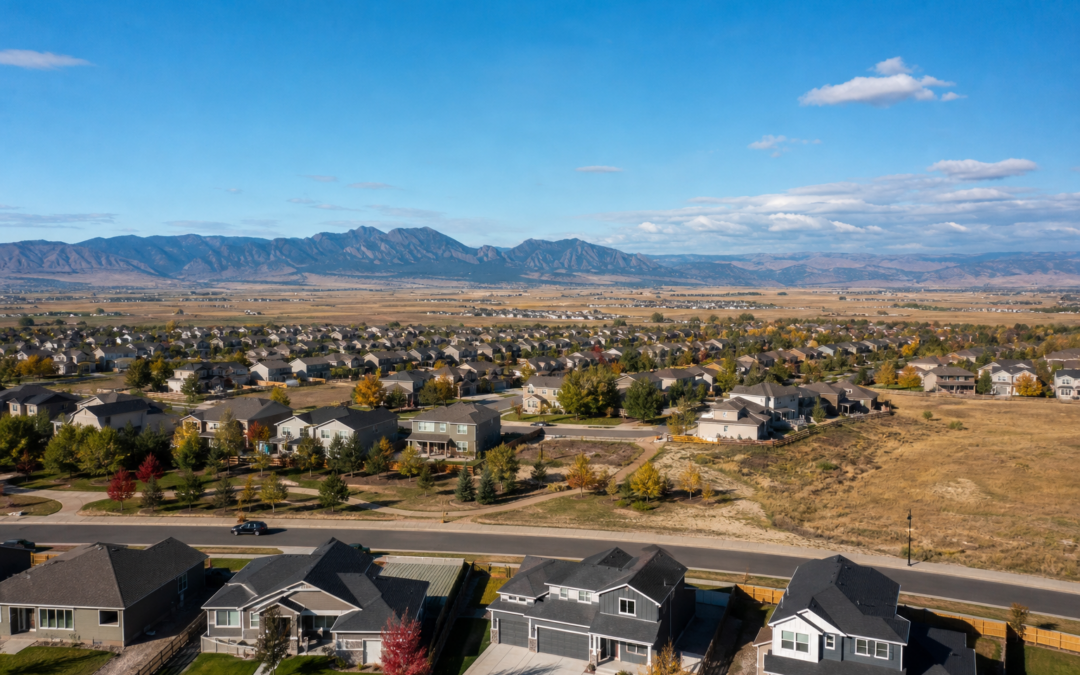
Severance has grown faster than almost any town in Northern Colorado. A community that had a few hundred residents not that long ago now has thousands, with new neighborhoods spreading across what was farmland a decade ago. If you live here, there’s a good chance your house is younger than your car.
That creates a specific water damage profile — different from what you’d see in older Greeley or Fort Collins neighborhoods. Here’s what Severance homeowners should watch for, and what to do when water shows up somewhere it shouldn’t.
Why New Homes Aren’t Immune (In Fact, They’re a Common Call)
The most common assumption we run into is that a newer home won’t have plumbing problems. The reality is the opposite in the first several years of a home’s life. Most water damage in new construction comes from installation issues, not wear:
- Connections that were never fully tightened — a supply line under a sink, a toilet feed, an ice maker line behind the fridge. These can seep for months before anyone notices, or let go all at once.
- Washing machine hoses that weren’t secured properly during install — and a failed washer hose can put out hundreds of gallons an hour.
- Water heaters that fail early due to a manufacturing defect or a bad fitting.
- Poorly seated toilet flanges that leak slowly into the subfloor, discovered only when the floor around the base gets soft.
- Roof and flashing details that weren’t finished perfectly, showing up as an attic or ceiling leak after the first big storm.
Local Conditions That Make It Worse
Soil that’s still settling. In newer Severance developments, backfill soil around foundations continues to compact for years. Grading that drained correctly at closing can slope back toward the house by year three, sending irrigation water and snowmelt against your foundation wall.
Heavy irrigation on new landscaping. New sod and young trees mean sprinklers running hard all summer. A cracked lateral line or a head spraying the foundation saturates the soil day after day — and that shows up as a damp basement wall, often blamed on rain that never came.
Finished basements everywhere. Nearly every home here has one, and a large share are finished into family rooms and bedrooms. That puts carpet, drywall, and flooring at the lowest point in the house, right where water collects.
Exposed high plains weather. Severance sits out in open country with little to break the wind. Front Range hailstorms hit hard here, and hail damage to a roof frequently doesn’t show up as a leak until weeks later. Fast-moving summer thunderstorms can overwhelm window wells and drainage in minutes.
Cold, windy winters. Wind chill on an exposed home drives freezing into crawl spaces, garages, and pipes running through exterior walls. Frozen and burst pipes are a real risk here every January.
The Calls We Get Most Around Severance
- Appliance failures — washers, dishwashers, water heaters, refrigerator ice maker lines
- Basement flooding and seepage after storms, snowmelt, or sprinkler line breaks
- Frozen and burst pipes after a hard freeze
- Roof leaks discovered well after a hailstorm
- Slow hidden leaks first noticed as a musty smell or an unexplained water bill jump
- Sewer and drain backups
What to Do in the First Few Minutes
- Shut off the water at the source or the main. Know where your main shutoff is before you need it.
- Cut power to affected areas at the breaker if water is near outlets or wiring — never wade through standing water to reach the panel.
- Photograph and film everything before you move or clean anything.
- Save the failed part — the burst pipe, the split hose. It’s proof of a sudden failure, which matters enormously for your claim.
- Call Revive at (720) 340-3499 before you call your insurance company. We’ll get there fast, start extraction, and document the damage properly.
If Your Home Is Still Under Warranty
Worth knowing: many newer Severance homes are still within a builder’s workmanship or systems warranty period. If a leak traces back to a plumbing installation defect, the repair itself may be the builder’s responsibility. That doesn’t slow down the restoration — the water still needs to come out today — but it’s a good reason to document everything thoroughly and keep the failed component. We’re happy to provide our findings to both your builder and your insurance carrier.
Why Fast Response Matters
Water travels. Within hours it wicks up drywall, soaks into subfloor, and spreads under flooring into rooms that look completely dry. Within 24 to 48 hours, mold can start in the wet materials — usually inside a wall cavity where you won’t see it for months.
The single biggest factor in whether a water loss becomes a dry-out or a demolition is how many hours the water sat. That’s why we run 24/7 with a 60-minute response time across Severance, Windsor, Eaton, and the surrounding area.
Locally Owned — We Actually Live Here
Revive Restoration is family-operated and locally owned by Levi, born and raised in Northern Colorado. We’re not a franchise routing your emergency call through an out-of-state dispatch center. We know these developments, these builders, and these winters, and we work with all insurance carriers.
If you’re seeing something and you’re not sure it’s a problem — a soft spot in the floor, a faint musty smell, a stain that might be new — call us anyway. We have moisture meters and thermal imaging that find water hiding inside walls and floors, and the inspection is free.
Water damage in Severance? Call Revive Restoration 24/7 at (720) 340-3499.
Serving Severance and All of Northern Colorado
Learn more on our Severance water damage restoration page. We also serve nearby communities including Windsor, Eaton, Greeley, Timnath, Fort Collins, and Johnstown. See the full list on our service areas page, or read about our water damage restoration services.