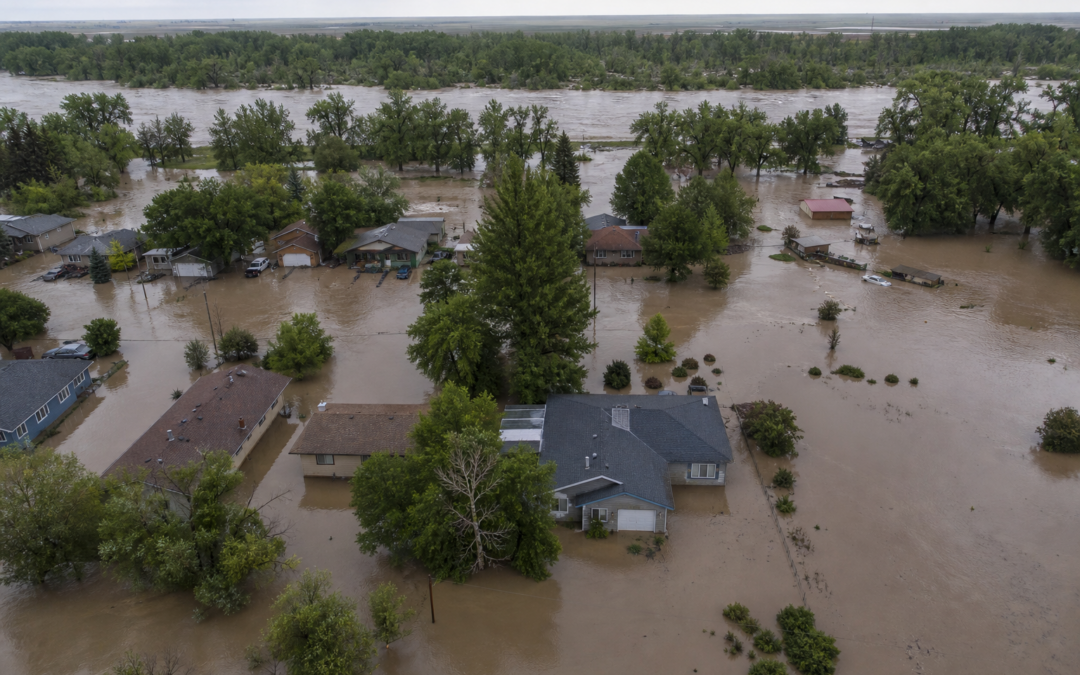
In September 2013, the South Platte and the Poudre came up together and Greeley and Evans took the worst of it in Weld County. County officials estimated roughly 2,900 residential properties were impacted. Hundreds of residents were displaced. It was described at the time as a 100-year event, and by some measures a 500-year one.
Here’s the part that still costs Greeley homeowners money more than a decade later: a great many of those flooded homes had homeowners insurance, and it didn’t cover the flood.
That’s not a loophole or a bad-faith denial. It’s how the policies are built, and almost nobody knows until they need it.
The Gap, Plainly Stated
Your standard homeowners policy covers water that comes at you from inside the house, suddenly and accidentally. A burst pipe. A failed washing machine supply line. A water heater letting go. That’s covered.
It generally does not cover water that arrives from outside and rises: river overflow, surface water running across the ground, mudflow, or groundwater pushing up through your slab. That’s flood, and flood is excluded from essentially every standard homeowners policy in the country.
Flood coverage is a separate policy — usually through the National Flood Insurance Program, sometimes through private carriers. You have to buy it deliberately.
And a third category catches people too: sewer backup, which is neither of the above and requires its own endorsement. In 2013 many Greeley basements didn’t take river water directly — they took sewage pushed backward through an overwhelmed collection system. Different cause, different coverage, same ruined basement.
“I’m Not in a Flood Zone, So I’m Fine”
This is the most expensive assumption in the category.
FEMA flood maps identify where flooding is most likely. They are not a promise about where water can go. Maps are updated on a slow cycle, and Greeley has been growing fast — new subdivisions, new impervious surface, new drainage patterns, annexations pushing west. Water behavior changes faster than maps do.
Two things worth knowing:
- A large share of flood claims nationally come from properties outside high-risk mapped zones.
- If you’re outside a high-risk zone, flood insurance is cheaper — often substantially. Preferred-risk policies exist precisely for this situation.
Being off the map is a reason to consider the coverage, not to dismiss it.
Where Greeley’s Actual Water Risk Sits
Some honest geography. Greeley’s exposure concentrates in a few patterns:
- The river corridors. East Greeley toward the confluence, the low ground near the South Platte and the Poudre. This is where 2013 did its worst, and it’s the most straightforward risk to understand.
- Irrigation infrastructure. Weld County is threaded with ditches, laterals and canals. They’re a working agricultural system, and when one overtops or breaches, the water goes wherever the terrain sends it — including into neighborhoods that have no river anywhere near them.
- Urban drainage during cloudbursts. A summer thunderstorm can drop rain faster than any storm system moves it. Low-lying streets, window wells and below-grade entries take water regardless of what any map says.
- Rapid snowmelt into saturated ground. Not dramatic, rarely on the news, and a steady producer of wet basements every spring.
Three Wet Basements, Three Different Answers
This is where our job overlaps with your claim. Consider three Greeley homes with two inches of water in the basement:
Home A — a supply line to the basement bathroom sink failed. Sudden, accidental, internal. Almost certainly covered by the homeowners policy.
Home B — the sewer backed up through the floor drain during heavy rain. Covered only if a water/sewer backup endorsement was added, usually to a specific limit.
Home C — water rose from outside and came in at the foundation. Not covered by homeowners at all. Needs a flood policy.
All three look identical when you walk down the stairs. The distinction is determined by cause, and cause is determined by evidence — which is exactly why the documentation done in the first hours matters so much.
What to Do Before Anything Happens
- Read your declarations page. Not the whole policy — just the first page, where limits and endorsements are listed. Look for a water backup or sewer backup line item. If it’s not there, you don’t have it.
- Call your agent and ask two questions: “Do I have sewer backup coverage, and what’s the limit?” and “What would a flood policy cost at this address?” Ten minutes on the phone.
- Note the waiting period. NFIP flood policies generally have a 30-day waiting period before they take effect. You cannot buy flood insurance when the forecast turns. Buy it on a clear day or not at all.
- Photograph your basement now, while it’s dry and full of your belongings. A pre-loss inventory makes the contents portion of any claim dramatically easier.
- Get things off the floor. Shelving twelve inches up turns a catastrophic loss into an annoying one.
- Check your grade and downspouts. The cheapest flood mitigation available is making sure water leaves your foundation instead of pooling against it.
If Water Is Already In
Safety first: if water is near the electrical panel or outlets, don’t enter. Rising outdoor water may also be contaminated — treat anything that came from a river, a ditch or a storm drain as Category 3, meaning porous materials that soaked it need to be removed rather than dried.
Then photograph everything before it moves, and call us before you call your insurer. On a flood-versus-plumbing question, the determination of cause drives the entire claim. Having moisture readings, thermal images and a documented scope in hand before that conversation starts is worth more than any argument you can make afterward.
We’ll also tell you honestly if we think the loss isn’t covered. That’s more useful to you than a hopeful guess.
Call Even If You’re Not Sure
If your basement smells like it took water while you were away, or a wall looks darker than it should, or you just want to know what you’re actually exposed to — call. The inspection is free, and knowing which of the three categories you’d fall into is worth having before the storm, not during it.
Water damage in Greeley? Call Revive Restoration at (720) 340-3499 — 24/7. Family operated since 2016, owned by Levi, born and raised in Northern Colorado.
See our full Greeley water damage restoration services, or read our other Greeley guides: sewer backups in Greeley basements, water damage in older Greeley homes, and what happens after you call. Also useful: does insurance cover water damage in Colorado and how to document a claim. We also serve Windsor, Johnstown and Loveland — full list on our service areas page.