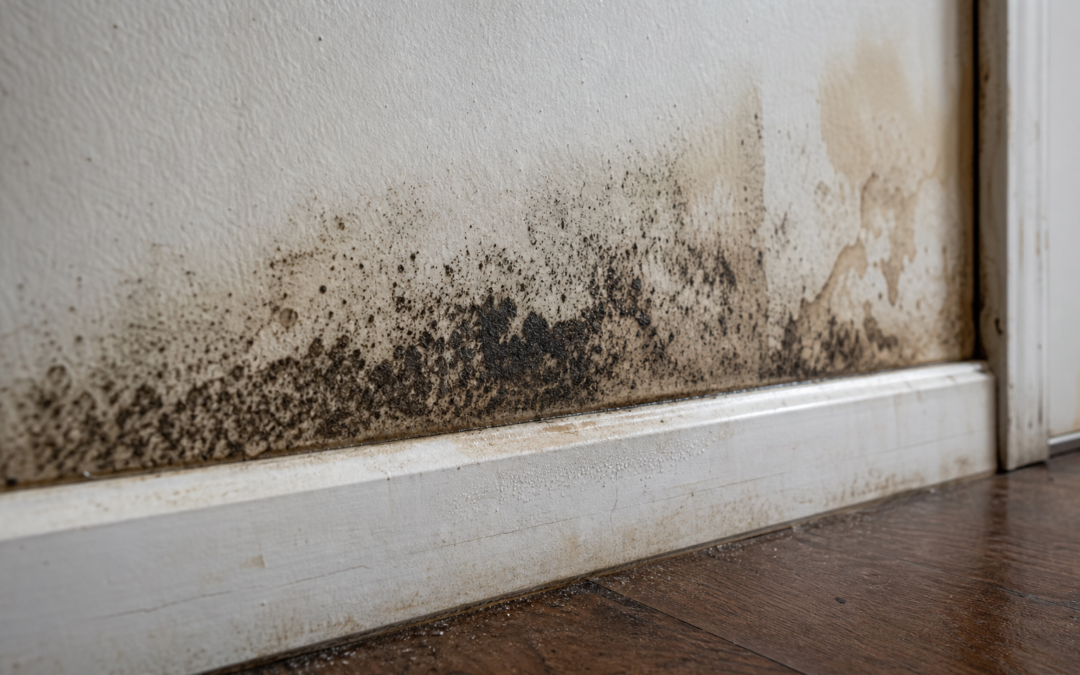
You pulled back the carpet, looked behind the washing machine, or opened a cabinet under the sink — and there it is. A dark patch on the drywall or subfloor that definitely wasn’t there before the leak. The first question almost everyone asks is the same one: is that black mold?
It’s a fair question, and it deserves a straight answer. Here’s how to tell what you’re actually looking at, what’s genuinely worth worrying about, and what to do next.
First: “Black Mold” Isn’t One Specific Thing
When people say “black mold,” they usually mean Stachybotrys chartarum — the greenish-black species that gets all the news coverage. But here’s what most homeowners don’t realize: dozens of common mold species are dark colored, and you cannot identify a species by looking at it. Neither can we, and neither can anyone else without a lab sample.
What matters more than the species is this: mold growing on wet building materials in your home needs to be dealt with, period. The color tells you very little. The moisture behind it tells you everything.
Mold vs. Mildew vs. Just Dirt
Not every dark spot is a remediation project. Here’s how the common culprits differ:
- Mildew is typically flat, powdery, and gray or white. It lives on surfaces — shower tile, grout, window sills — and usually wipes away with a household cleaner without leaving damage behind.
- Surface mold looks fuzzy or velvety and can be green, gray, brown, or black. It often has a slightly raised, textured appearance. If it’s confined to a hard, non-porous surface, it may be manageable.
- Mold growing into porous materials — drywall, insulation, carpet padding, subfloor, ceiling tile — is the serious one. It doesn’t wipe off, because the growth extends through the material, not just on top of it. This is what follows a water leak.
- Soot, dirt, or water staining can look alarmingly like mold. A brown ring on a ceiling from an old roof leak is often just mineral staining. If it’s smooth, flat, and doesn’t smear or smell, it may not be mold at all.
A quick field test: mold has a distinct musty, earthy smell — that “old basement” odor. If you smell it, there’s active moisture somewhere, even if you can’t see the source.
Why a Water Leak Changes the Equation
Mold spores are everywhere, all the time, indoors and out. They’re harmless until they get three things: moisture, a food source (drywall paper, wood, dust), and time. A water leak delivers all three at once.
That’s why mold after water damage behaves differently than the spot of mildew in your shower. It typically:
- Starts within 24–48 hours of materials getting wet
- Grows where you can’t see it first — inside wall cavities, under flooring, behind baseboards, in insulation
- Keeps spreading as long as the material stays damp, even if the visible surface looks dry
This is the part that catches homeowners off guard. The patch you can see is often the smallest part of the problem. If a wall got soaked, the growth inside that wall cavity is usually far larger than what shows on the surface.
Health Symptoms That Mean Stop Guessing
You don’t need to panic about every dark spot. But pay attention if people in the house are experiencing:
- Persistent coughing, sneezing, or a runny nose that improves when you leave the house
- Itchy or watery eyes, skin irritation, or throat irritation with no obvious cause
- Worsening asthma symptoms or new shortness of breath
- Headaches or unusual fatigue that track with time spent in a particular room
Infants, older adults, and anyone with asthma, allergies, or a compromised immune system are more sensitive. If symptoms line up with a room where you had a leak, that’s your signal to get it professionally assessed rather than guessing.
Why DIY Mold Removal on Water-Damaged Areas Backfires
We understand the instinct — grab bleach and a scrub brush and make it go away. Here’s why that usually makes things worse on water-damaged materials:
- Bleach doesn’t work on porous surfaces. It kills what’s on top while the water carrier soaks deeper into the drywall or wood, sometimes feeding the growth underneath.
- Scrubbing releases spores into the air. Disturbing a colony without containment spreads it to rooms that were previously clean. We’ve been called into homes where a small closet problem became a whole-floor problem after a weekend of DIY.
- It hides the real issue. If the moisture source isn’t found and fixed, and the material isn’t properly dried, it comes back — usually within weeks.
- It can complicate your insurance claim. Removing or altering damage before it’s documented can undercut your coverage.
Cleaning a few square inches of surface mold on shower tile is a fine weekend job. Mold on drywall, carpet, insulation, or subfloor after a leak is not.
When to Call a Professional
Call us if any of the following apply:
- The affected area is larger than roughly 10 square feet
- It’s growing on drywall, insulation, carpet, or subfloor rather than a hard surface
- You can smell mustiness but can’t find the source
- It came back after you cleaned it
- Anyone in the home is having health symptoms
- It followed a known water event — burst pipe, appliance leak, roof leak, flooded basement
What we do differently: we find the moisture first. Using moisture meters and thermal imaging, we map exactly how far the water traveled inside your walls and floors, then contain the area, remove affected materials safely, dry the structure properly, and fix the conditions that let it grow. Guessing is what turns a small job into a big one.
Talk to Us Before You Call Insurance
Revive Restoration is locally owned and family-operated here in Northern Colorado, available 24/7 with a 60-minute response time, and we work with every insurance carrier. If you call us first, we can document the damage properly from the start — which consistently makes for a stronger, smoother claim.
And if you’re not sure whether what you’re looking at is a real problem? Call anyway. We’d rather take a look and tell you it’s nothing than get called back in three months when it isn’t. The inspection is free.
Found mold after a leak? Call Revive Restoration at (720) 340-3499.
Serving All of Northern Colorado
We handle mold and water damage across the Front Range, including Fort Collins, Loveland, Greeley, Windsor, Longmont, and Johnstown. Browse every community we serve on our service areas page, or read more about our mold remediation services.