
The storm rolls through in twenty minutes. Your car has dents, the garden’s shredded, and the roof… looks fine from the driveway. So you move on.
Six weeks later there’s a brown ring on the guest room ceiling and a musty smell in the hallway closet, and nobody can figure out where it came from. That’s the part of Colorado hail season nobody warns you about: the leak usually shows up long after the storm does.
Why hail damage doesn’t leak right away
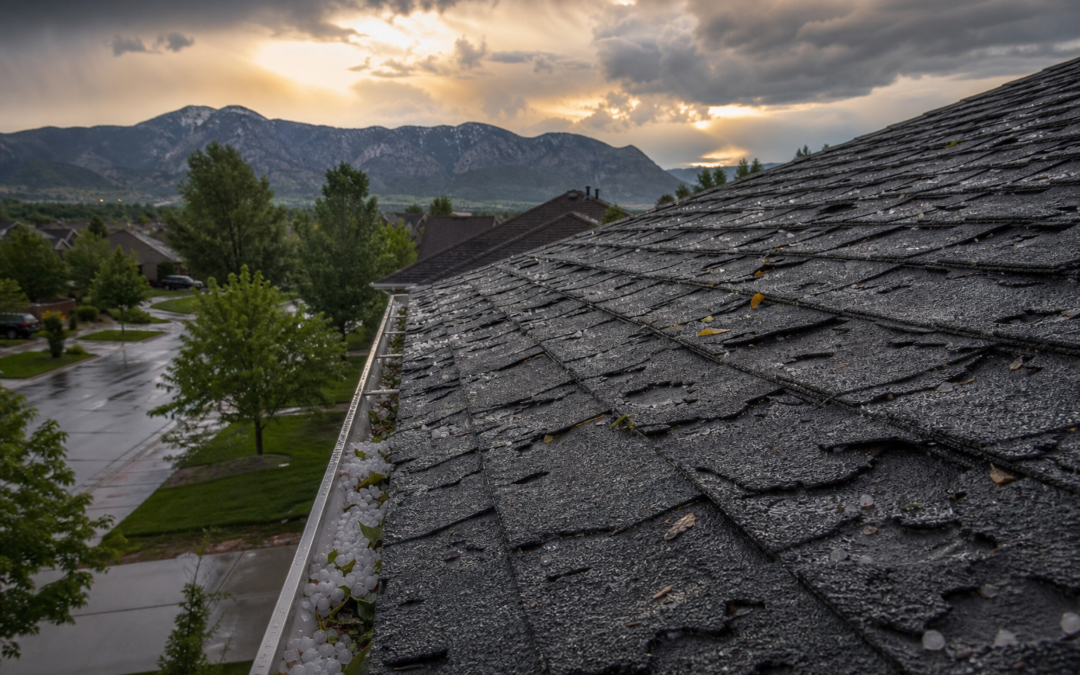
Hail rarely punches a hole through a roof. What it does is far sneakier — it bruises.
An impact knocks the protective granules off asphalt shingles and fractures the mat underneath. From the ground, the shingle still looks like a shingle. But that spot is now exposed to UV, and Front Range sun degrades the bare mat quickly. Meanwhile the same storm loosens flashing around chimneys, vents, and valleys, and dings gutters and downspouts just enough to change how water drains.
Then it takes a second event to finish the job — a hard August rain, an early snow that melts and refreezes, wind driving water sideways under the lifted edge. Water finds the compromised spot, runs down the decking, follows a rafter, soaks insulation, and only reaches your drywall once enough of it has collected. That delay is routinely two weeks to three months.
By then it doesn’t look like storm damage. It looks like a mystery leak. And that’s exactly where claims go sideways.
Warning signs inside your house
Long before there’s a puddle, the house tells you. Watch for:
- Ceiling stains — faint tan or brown rings, especially near exterior walls, valleys, or below a chimney
- A musty smell in a closet, upstairs hallway, or the attic hatch area
- Bubbling or peeling paint on ceilings and upper walls
- Nail heads rusting or dark streaks on attic decking
- Matted, damp, or discolored insulation in the attic
- Daylight visible through the roof deck from inside the attic
- Higher humidity or condensation on upstairs windows
Outside, look for granules collecting in gutters and at downspout outlets, dented soft metals (gutter aprons, vents, AC fins), and shingles with dark bruised circles where granules are missing. If your car got dented, your roof took the same hits.
Why delayed damage gets claims denied
This is the expensive part. Insurance policies cover sudden and accidental damage from a covered peril — a hailstorm qualifies. What they don’t cover is long-term seepage, gradual deterioration, or neglected maintenance.
When you report a leak three months after the storm with no documentation, the adjuster has a reasonable question: how do we know this came from that hail, and not from a roof that was simply worn out? Carriers also apply time limits for reporting a loss, and many Colorado policies now use separate wind/hail deductibles or roof surfacing payment schedules that reduce what’s paid on older roofs.
Three things protect you:
- Get inspected right after the storm, before any leak appears. A dated report tying damage to a specific storm is the single strongest piece of evidence you can have.
- Document immediately when you do find interior damage — photos, dates, moisture readings.
- Mitigate promptly. Every policy requires you to prevent further damage. Letting it run for weeks after you noticed gives the carrier a reason to reduce payment.
The mold clock nobody accounts for
A slow roof leak is close to ideal conditions for mold: dark, still, insulated, and consistently damp. Mold can begin growing on wet organic material in 24 to 48 hours, and a leak that’s been running quietly since a July storm has had months. Attic insulation acts like a sponge and hides it. That’s why we so often find that the visible stain on the ceiling is a fraction of the real footprint upstairs.
Call Revive before you call insurance
We say it on every post because it keeps paying off. When we inspect first, we map the moisture with meters and thermal imaging, trace the water back to its actual entry point, and give you a documented scope before a claim number exists. Then you file with facts, not a description of a stain. Claims move faster, denials drop, and you find out what’s really wet — not just what’s visible.
We handle the water side end to end: extraction, structural drying, antimicrobial treatment, insulation and drywall replacement, and full repairs in-house.
Hail hits everywhere on the Front Range
Our region takes some of the highest hail frequency in the country, and we respond 24/7 across it — Greeley, Fort Collins, Loveland, Windsor, Johnstown, Berthoud, Longmont, Evans, Firestone, and Brighton. Full list on our service areas page, plus details on water damage restoration and mold remediation.
Storm rolled through your neighborhood? Get ahead of it. Call Revive Restoration at (720) 340-3499 for a free post-hail inspection — before a bruised shingle becomes a bedroom ceiling.