

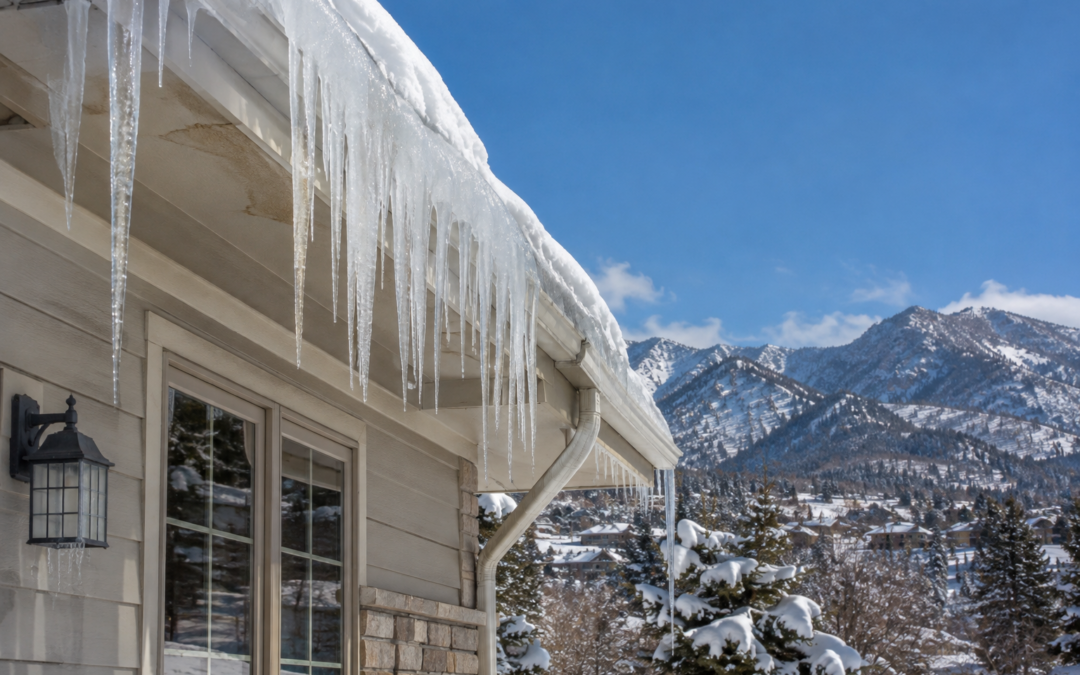
The snow looks beautiful on the roof. A few days later, there’s a brown ring on the bedroom ceiling, the paint is bubbling by the window, and you can’t work out how water got in when nothing’s raining.
In many Northern Colorado homes, the cause is an ice dam. It’s one of the most common winter roof leaks we see, and one of the easiest to miss. The water damage starts in the attic and inside the walls long before you notice anything in your living space.
With the first real snow of the season on its way to the Front Range, here’s what Johnstown, Loveland, Windsor, Fort Collins, Greeley and other homeowners across the region should know.
What Is an Ice Dam?
An ice dam is a ridge of ice that builds up along the lower edge of the roof, at the eaves and gutters. It traps melting snow behind it. That water has nowhere to go, so it backs up under the shingles and leaks into the attic, the walls and the ceilings below.
Here’s how it happens:
- Heat escapes into the attic. Warm air from your living space leaks up through gaps around light fixtures, attic hatches, bath fans and thin insulation.
- The upper roof warms up. That heat melts the bottom layer of snow on the roof, even when it’s below freezing outside.
- Meltwater runs down to the cold eaves. The overhang sits outside the heated part of the house, so it stays cold.
- The water refreezes. Each melt-and-freeze cycle adds to the ridge of ice until it’s tall enough to hold back a pool of water.
Colorado winters are made for this. We get heavy snow, then bright sun, then hard freezes at night, often all in the same week. Those quick swings are exactly what builds ice dams.
Warning Signs of an Ice Dam
Check your roof and your ceilings after every big snow, and especially once the sun comes back out:
- Thick ice along the gutters or roof edge, often with a ridge you can see from the ground
- Large icicles, especially ones with water dripping behind them or forming on the siding
- Water stains or bubbling paint on ceilings near exterior walls
- Damp or stained drywall around window frames on upper floors
- Wet or matted insulation, or frost on the underside of the roof deck, if you can safely look into the attic
- A musty smell upstairs or in closets along exterior walls
- Bare patches on a snowy roof while the rest stays covered, which is a sign of heat escaping in that spot
Icicles alone don’t always mean trouble. Icicles plus a stain inside means water is already getting in.
Why Ice Dam Leaks Do So Much Damage
An ice dam leak isn’t a single drip. It’s a slow, steady soak that can go on for days or weeks while snow keeps melting. By the time a stain shows up on the ceiling, the water has usually already:
- Soaked attic insulation, which then stops insulating and makes the ice dam worse
- Run down inside exterior walls, behind drywall where you can’t see it
- Wet the roof decking and framing
- Started the mold clock. Mold can begin growing on wet building materials within 24 to 48 hours.
That’s why a “small” ice dam stain often turns into a much bigger job once someone opens up the wall.
How to Prevent Ice Dams (Safely)
The real fix is keeping the roof deck cold so the snow doesn’t melt from below:
- Seal air leaks into the attic. Gaps around recessed lights, plumbing stacks, chimneys, attic hatches and bath fans are the usual suspects.
- Add attic insulation if yours is thin or uneven.
- Make sure the attic is properly vented so cold outside air can move under the roof deck.
- Vent bathroom and kitchen fans outdoors, not into the attic.
- Keep gutters and downspouts clear before the snow flies, so meltwater has a path off the roof.
- Use a roof rake from the ground to pull the first few feet of snow off the roof edge after a heavy storm.
Please don’t climb on an icy roof, and don’t chip at ice dams with a hammer, an axe or a shovel. You can tear shingles, damage gutters, or get seriously hurt. Heat cables can help in trouble spots, but they’re a patch rather than a cure. If you have a big ice dam already, call a roofer who does safe ice dam removal, usually with low-pressure steam.
Water Is Coming Inside. Now What?
If an ice dam is already leaking into your home, here’s what to do:
- Protect people and power. If water is dripping near a light fixture, outlet or ceiling fan, turn off that circuit at the breaker.
- Catch the water. Set out buckets and towels, and move furniture, rugs and electronics out of the way.
- Relieve a sagging ceiling carefully. If a ceiling is bulging with water, keep everyone out from under it. Don’t push on it.
- Document everything. Take photos and video of the ice on the roof, the stains, and any damaged belongings before you clean up.
- Call Revive before you call your insurance company. We’ll find out how far the water has spread inside the walls and the attic, start drying, and document the damage in a way that supports your claim.
Call Revive Before You Call Insurance
Ice dam damage hides in insulation, wall cavities and framing. If you file a claim before anyone has measured that moisture, it’s easy to underestimate the damage. That means a smaller payout and hidden mold down the road.
When you call Revive first, we use moisture meters and thermal imaging to map exactly where the water went. We start drying right away and give you documentation your adjuster can work with. We work with every insurance carrier, and the inspection is free.
Revive Restoration is family-owned and based in Johnstown, and we’ve been restoring Front Range homes since 2016. We answer the phone 24/7, snowstorms included.
Seeing a stain after the snow? Call Revive Restoration at (720) 340-3499 before you call your insurance company.
Ice Dam FAQs
Does homeowners insurance cover ice dam damage in Colorado?
Many homeowners policies cover sudden water damage inside the home from an ice dam, like wet ceilings, walls and insulation. Coverage for the roof itself, or for damage blamed on poor maintenance, varies from policy to policy. That’s why it helps to have the damage professionally documented before you file. Call Revive first and we’ll help you understand what the adjuster will look for.
Are icicles on my gutters a sign of an ice dam?
Not always, but they’re a warning sign. Small icicles are common in Colorado. Thick ice along the roof edge, icicles forming behind the gutter or on the siding, or any water stain on the ceiling inside points to an ice dam that’s letting water in.
Can I remove an ice dam myself?
You can safely use a roof rake from the ground to clear snow off the first few feet of the roof. Don’t climb onto an icy roof or chip at the ice with tools. That can damage shingles and gutters and cause serious falls. For ice that’s already built up, hire a roofer who uses steam removal.
How long does it take for mold to grow after an ice dam leak?
Mold can start growing on wet drywall, insulation and wood within 24 to 48 hours. Ice dam leaks often go unnoticed for days, so mold may already be starting by the time you see a stain. Fast professional drying is the best way to stop it.
What should I do first if an ice dam is leaking into my house?
Turn off power to any wet light fixtures or outlets, catch the water, move your belongings, and take photos. Then call Revive Restoration at (720) 340-3499 before you call your insurance company, so the hidden moisture gets measured and documented right away.
Related reading: attic water damage signs and causes, roof leak water damage, and how to winterize your home before the first freeze.
Serving All of Northern Colorado
We handle ice dam and roof leak water damage in Johnstown, Loveland, Windsor, Fort Collins, Greeley, Berthoud, Timnath, Severance, Wellington, and Longmont. See every community we serve on our service areas page, or learn more about our water damage restoration and mold remediation services.