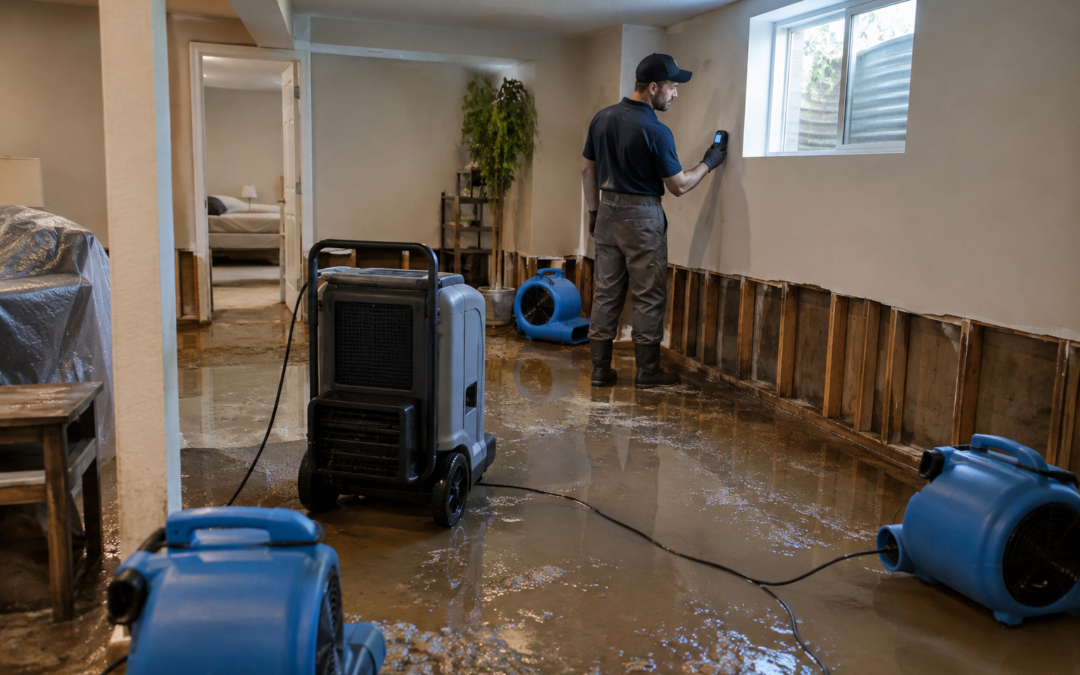
The rain finally stops. The sirens fade. And now you’re standing at the top of your basement stairs looking at water where your family room used to be.
If you’re reading this in the middle of a flood, take a breath. You’re not the first Colorado family to go through this, and you won’t be the last. Our state has a long flood history — the 1965 South Platte flood that tore through Denver, the 1976 Big Thompson flood west of Loveland, and the September 2013 floods that hit Lyons, Estes Park, Evans, Longmont and much of the Front Range all at once. Every one of those disasters taught the same lesson: what you do in the first 48 hours decides how much of your home you get back.
Here’s the plan, hour by hour, for homeowners across Northern Colorado and the Denver metro.
Hours 0–2: Safety Before Anything Else
Your home can be replaced. You can’t. Before you think about furniture or photos, check these off:
- Don’t drive or walk through moving water. The National Weather Service warns that six inches of fast-moving water can knock an adult off their feet, and about a foot can float a car. Turn around, don’t drown.
- Stay out of a flooded basement if the power is on. Water and live outlets, furnaces, or water heaters are a deadly combination. If you can’t reach your breaker panel from a dry spot, call your utility (Xcel Energy, Poudre Valley REA, United Power, or your city utility) and let them cut it.
- Smell gas? Get out and call your gas provider from outside.
- Follow evacuation orders. If your county has told you to leave, leave. Come back only when officials say it’s safe.
- Treat all floodwater as contaminated. Outdoor floodwater carries sewage, fuel, chemicals and debris. Wear rubber boots and gloves, and keep kids and pets away from it.
Hours 2–6: Stop the Damage From Spreading
Once everyone is safe, the goal shifts to keeping a bad day from turning into a worse month.
- Find the source if it’s internal. Storms often cause indoor flooding too — sump pumps fail, window wells fill, sewer lines back up. Shut off the main water valve if a pipe or fixture is involved.
- Move what you can to higher ground. Get electronics, important documents, medications and irreplaceable keepsakes upstairs or out of the house.
- Don’t start tearing things out yet. It feels productive, but ripping out carpet and drywall before it’s documented can hurt your insurance claim or disaster assistance application.
Hours 6–12: Document Everything
Pull out your phone. Before you clean a single thing:
- Take a slow walkthrough video of every affected room, narrating what happened and when.
- Photograph the water line on walls, furniture and appliances. Mark the high point with tape if the water is going down.
- Photograph damaged belongings one by one, including serial numbers on appliances and electronics.
- Save every receipt from here on — hotel nights, fuel, fans, tarps, meals.
- Back everything up to the cloud.
We cover this step in detail in how to document water damage for your insurance claim.
Hours 12–24: Call Revive Before You Call Insurance
This is the step that surprises people. Most homeowners call their insurance company first, get put on hold behind every other family in the county, and wait days for an adjuster while their walls soak up water.
When you call Revive first, we come out, assess the damage, and document it with professional tools — moisture meters and thermal imaging that show where water has traveled inside walls, under flooring and into the subfloor. That’s damage you can’t see in photos, and it’s exactly what gets missed when a claim is written off a quick visual inspection. We then start water extraction and drying right away, which limits further damage (something your policy expects you to do anyway), and we work directly with every insurance carrier.
If you’re already in a declared disaster area, you’ll also want to register for federal help. Our guide to disaster relief after a Colorado flood walks through FEMA, SBA loans and how they fit with insurance.
Hours 24–48: Beat the Mold Clock
Mold can start growing on wet drywall, carpet pad and wood within 24 to 48 hours. After a regional flood, that clock is running in thousands of homes at once, which is why getting on a restoration company’s schedule early matters so much.
- Get water out fast. Standing water needs to be extracted with commercial pumps and vacuums, not towels and a shop vac.
- Pull out what can’t be saved. Carpet pad, insulation and drywall touched by outdoor floodwater usually need to go — it’s contaminated, not just wet.
- Dry the structure, not just the surface. Commercial air movers and dehumidifiers, checked daily with moisture readings, are what keep mold from showing up three weeks later behind a freshly painted wall.
If you’re going to clean up any of it yourself, read safe re-entry and what not to DIY after a flood first.
A Few Hard Truths About Flood Coverage
We’d rather you hear this from us now than from an adjuster later:
- Standard homeowners policies usually exclude flooding from rising outdoor water. That takes a separate flood policy through the National Flood Insurance Program or a private carrier.
- Sewer backup is usually a separate endorsement, too.
- But not every “flood” is a flood in insurance terms. A burst pipe, a failed sump pump or a storm-driven roof leak may be covered under your homeowners policy. Don’t assume you’re not covered. Report it and let the process decide.
For more, see does homeowners insurance cover water damage in Colorado?
You Don’t Have to Figure This Out Alone
Revive Restoration is a locally owned, family-run company based in Johnstown. Our owner, Levi, was born and raised in Northern Colorado. When a flood hits, we’re not a call center two states away. We’re your neighbors, and we answer the phone 24/7.
Whether it’s a few inches in the basement or a whole-home loss, the inspection is free and we’ll tell you honestly what you’re dealing with.
Flooded right now? Call Revive Restoration at (720) 340-3499 before you call your insurance company.
Serving Northern Colorado and the Denver Metro
We handle flood and water damage restoration across the Front Range, including Fort Collins, Loveland, Greeley, Windsor, Johnstown, Longmont, Broomfield, Westminster, Thornton, and Arvada. See every community we cover on our service areas page, or learn more about our water damage restoration services.